

Hi friends,
We’ve come to a point - in my opinion - ‘between a rock and a hard place’.
Evidence points to the fact that AI is critical to national security. And we’re being told that it must be rushed due to the race with China. That’s a post for another day.
Part 1 was The Resistance Is Building
Part 2 is below.
Part 2
If the first phase of the AI debate was about whether data centers should be built, the second phase is about how they should be built.
That distinction matters.
Because despite the growing opposition, there is mounting evidence that demand for AI computing power is real.
One of the clearest signs came when reports surfaced that Google agreed to pay roughly $920 million per month for access to AI computing capacity through SpaceX. Google already operates some of the world’s largest data centers, yet it was willing to spend billions of dollars to obtain additional computing resources.
That suggests the industry is facing genuine infrastructure constraints.
The AI race is no longer just about software.
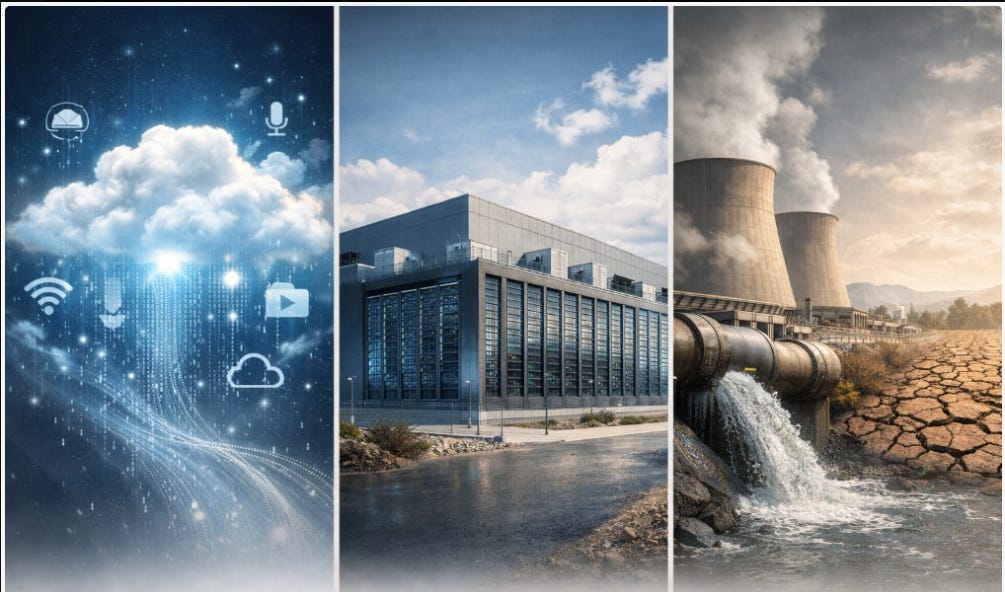
It is about electricity, water, land, cooling systems, substations, transmission lines, and computer chips.
In short, it is an infrastructure race.
Supporters argue that America cannot afford to fall behind China in artificial intelligence. They point to national security concerns, economic competition, and the possibility that AI could reshape industries in much the same way the internet did a generation ago. I don’t disagree.
Those arguments do not answer the concerns being raised by communities across the country.
Many Americans are not asking whether AI should exist.
They are asking whether local residents should bear the costs of building the infrastructure that supports it. And even more - transparency and upfront information, not NDAs and behind closed doors deals.
Increasingly, the industry is responding with proposed solutions. But many questions and concerns remain unanswered.
Some developers are promoting facilities powered by dedicated natural gas plants rather than drawing power from the local grid. Others are exploring nuclear power. Some projects propose using non-potable or produced water rather than competing with municipal supplies. Closed-loop cooling systems are being promoted as a way to reduce water consumption.
In Texas, discussion has begun around requiring stronger protections related to water use, power reliability, and infrastructure planning. Policymakers are beginning to recognize that communities want more than assurances. They want enforceable standards.
That may be the most important shift taking place.
For years, the debate centered on whether data centers would bring jobs and economic growth.
Today, the discussion is increasingly focused on conditions.
Should projects disclose expected water use?
Should they provide their own power generation?
Should counties have greater authority to review impacts?
Should facilities be restricted near schools or residential areas?
Should developers be required to contribute to infrastructure upgrades before construction begins?
These are not anti-technology questions.
They are governance questions.
Supporters often point to voluntary commitments from technology companies, including investments in water conservation and energy programs. Such efforts may help - if the commitments are followed and audited. But communities are increasingly asking whether voluntary commitments are enough when the projects themselves involve investments measured in billions of dollars.
For decades, Americans have been told that major infrastructure projects require careful consideration of environmental impacts, land use, water consumption, and community effects. Many citizens are now asking why AI infrastructure should be treated differently.
America does not have to choose between technological leadership and protecting local communities.
It can do both.
But doing both requires honesty.
It requires acknowledging that the concerns are real.
It requires recognizing that the benefits are real.
And it requires establishing the rules before the infrastructure becomes permanent.
The future of AI may depend on computers and algorithms.
But the future of communities depends on something else: whether growth happens with the people who live there—or simply happens to them.
People should be prioritized above big business.
And one basic tenet is being largely ignored: Farmland lost to technology is lost forever. Agricultural land, farms and ranches, means food.
As always, do your own research and make up your own mind.
White paper on land and water rights: Property Rights and Freedom: A White Paper on America’s Disappearing Land (8/13/2025)
United we stand. Divided we fall. We must not let America fall.
VoteTexas.gov, https://www.votetexas.gov/get-involved/index.html
Disclaimer:
As always, do your own research and make up your own mind. This Substack is provided for informational and commentary purposes only. All claims or statements are based on publicly available sources and are presented as analysis and opinion, not legal conclusions.
No assertion is made of unlawful conduct by any individual, company, or government entity unless such claims are supported by formal public records or verified legal documents. The views expressed here reflect my personal perspective on property rights and land use issues.
While I strive for accuracy and transparency, readers are encouraged to verify all details using the official sources and references provided. Any references to third-party material are included solely for your consideration and do not necessarily reflect my views or imply endorsement.
If you share this content, please include this disclaimer to preserve context and clarity for all readers.
Until next time…
Please share your thoughts in the comments. Or email me, and let’s have a problem-solving conversation. I welcome ‘letters to the editor’ type emails and may publish yours. I hope we can create a caucus with positive, back-to-the-founders’-dream-for-America results. Have a topic you want to know more about?
Some housekeeping…
Going forward, you may need to check your spam folder. And please mark this address as ‘not spam.’ If the newsletter isn’t in your spam folder either, you should look in the Promotions tab.
You can always see everything on the website, RationalAmerican.org.
Thanks again for reading! I’m glad you’re here!
It seems to me that the best way to address citizen concern over data center utility use is to make them independent of the local utilities.
Closed loop environmental controls do a lot to reduce water usage, and the load on the local water company can be reduced to zero by requiring the use of reconditioned waste water.
As for energy, local generation seems like a possibility, however the residents near Musk's Memphis facility have complained about noise, so the standards for noise pollution should probably be tightened for any data center generation facility.
The most effective tool to control how new data centers affect your neighborhood is to attend city council and county government meetings, make your views known, and insure your views are factual.
Ask the questions - what is your power and water use forecast? How much noise will be generated by the facility, and how far must a residence be to not be negatively effected by the noise? How many construction jobs will the project create? How many full-time jobs ongoing after completion? Where will the labor and employees be recruited from? What are the tax implications? Will the city/county collect taxes or will the data center be incentivised by tax breaks to locate near you?
These are all things we must, as informed citizens, know in order to make a decision on whether we want a facility built or not. We've had data centers as neighbors for many years, and most are good for the community, providing jobs and tax revenue for communities that need both. Find out what's being proposed before deciding approval will end civilization as you know it.