

Hi friends,
We’ve come to a point - in my opinion - ‘between a rock and a hard place’.
Evidence points to the fact that AI is critical to national security. And we’re being told that it must be rushed due to the race with China. That’s a post for another day.
This Part 1 is people are concerned and raising issues.
Part 2 will be about possible resolution, ‘The Infrastructure Question: If America Needs AI, How Should We Build It?’
Part 1
A year ago, most Americans had never given a thought to data centers.
Today, communities across the country are fighting over them.
City councils are debating them. Counties are trying to slow them down. Citizens are organizing against them. Lawsuits are being filed. In California, voters recently approved a permanent ban on new data centers. In Texas, counties are scrambling to understand projects that could reshape their communities for decades.
At first, data centers were presented as a simple economic development story. They would bring jobs, tax revenue, and technological progress. Communities were told they were essential for America’s future and its ability to compete in the rapidly growing field of artificial intelligence.
But as projects have moved from PowerPoint presentations to real-world proposals, many citizens have begun asking questions.
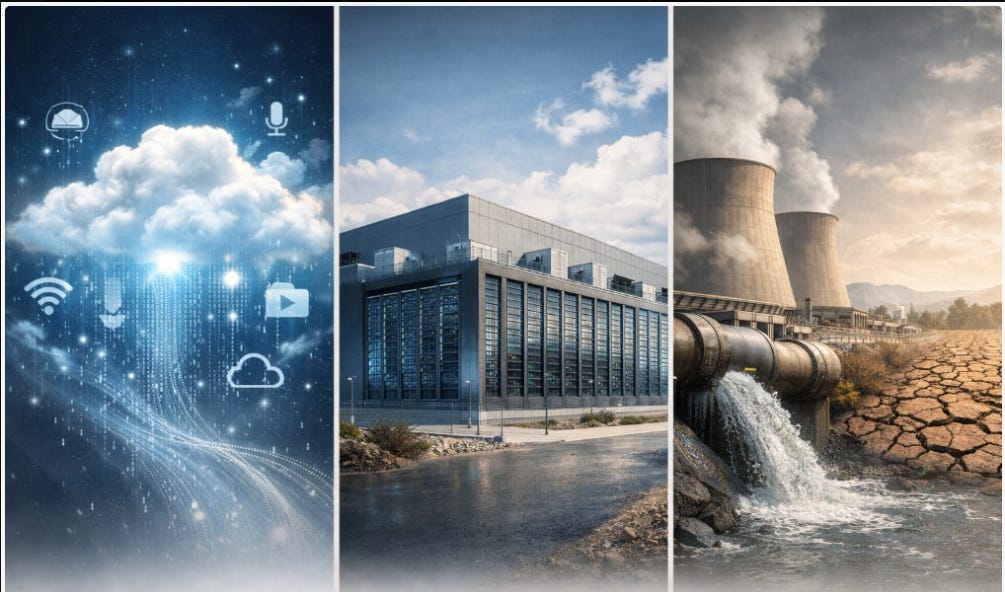
How much water will these facilities use?
How much electricity will they require?
Who pays for the new infrastructure?
Will farmland disappear beneath concrete and steel?
Will local residents have any meaningful say in the process?
Those questions are no longer theoretical.
In Texas, Hill County attempted to pause data center development while officials studied potential impacts. The county later rescinded the moratorium after facing a $100 million lawsuit from a developer. In Georgia, homeowners are fighting transmission-line projects tied to growing power demands. Across the country, residents are increasingly discovering that AI infrastructure is not just a technology issue—it is a land-use issue, a water issue, a power issue, and a quality-of-life issue.
One of the most significant recent developments came from Monterey Park, California, where voters overwhelmingly approved a permanent ban on new data centers. Whether one agrees with the decision or not, the vote demonstrated something important: citizens want a voice in these decisions.
The concerns vary by location.
In some communities, water is the dominant issue. In others, it is power demand, farmland preservation, property rights, noise, or local control. Residents near a Memphis-area facility associated with Elon Musk’s xAI recently filed a class-action lawsuit alleging that power generation equipment serving the project has negatively affected their quality of life and property values.
What ties these disputes together is not opposition to technology itself.
Many of the people raising concerns use AI every day. Many support innovation. Many support economic growth.
What they oppose is the idea that large-scale infrastructure projects should move forward without transparent discussion of the costs and consequences.
Erin Brocovich reports on what she’s learning bout lack of transparency. See the 5-minute CNN clip with Erin Brocovich.
Supporters of data centers often point to projected tax revenue, construction jobs, and national/international competitiveness. Critics point out that some facilities employ relatively few permanent workers once construction is complete. Communities are increasingly asking whether the promised benefits justify the tradeoffs.
The debate has also revealed a deeper issue: local control.
Many proposed facilities are being directed toward rural or unincorporated areas where local governments have fewer tools to regulate development. Residents often feel that major decisions are being made long before they learn the details.
That frustration is becoming political.
What began as a handful of local disputes has grown into a national conversation involving state legislatures, county governments, utility commissions, courts, and voters.
The resistance is building because the impacts are visible.
The question now is not whether data centers are coming.
The question is whether communities will have a meaningful role in deciding how they are built, where they are built, and what protections are put in place.
Because while the resistance is growing, so is the pressure to build.
And that raises an equally important question: If America truly needs this infrastructure, what should responsible development look like?
As always, do your own research and make up your own mind.
White paper on land and water rights: Property Rights and Freedom: A White Paper on America’s Disappearing Land (8/13/2025)
United we stand. Divided we fall. We must not let America fall.
VoteTexas.gov, https://www.votetexas.gov/get-involved/index.html
Disclaimer:
As always, do your own research and make up your own mind. This Substack is provided for informational and commentary purposes only. All claims or statements are based on publicly available sources and are presented as analysis and opinion, not legal conclusions.
No assertion is made of unlawful conduct by any individual, company, or government entity unless such claims are supported by formal public records or verified legal documents. The views expressed here reflect my personal perspective on property rights and land use issues.
While I strive for accuracy and transparency, readers are encouraged to verify all details using the official sources and references provided. Any references to third-party material are included solely for your consideration and do not necessarily reflect my views or imply endorsement.
If you share this content, please include this disclaimer to preserve context and clarity for all readers.
Until next time…
Please share your thoughts in the comments. Or email me, and let’s have a problem-solving conversation. I welcome ‘letters to the editor’ type emails and may publish yours. I hope we can create a caucus with positive, back-to-the-founders’-dream-for-America results. Have a topic you want to know more about?
Some housekeeping…
Going forward, you may need to check your spam folder. And please mark this address as ‘not spam.’ If the newsletter isn’t in your spam folder either, you should look in the Promotions tab.
You can always see everything on the website, RationalAmerican.org.
Thanks again for reading! I’m glad you’re here!