

Hi friends,
It cannot be overstated how important it is for us to be informed and engaged in how our land and water are used. It seems this is still a big blind spot for many people.
If you aren’t aware of re-purposing farmland to benefit government and big business, of government and big business being prioritized for water use, then please get informed and stand up. Your future food and water depend on it.
Most of us don’t spend much time thinking about cattle numbers, water permits, or land-use planning. Life is busy, headlines are exhausting, and those topics can feel far removed from everyday concerns. But over time, they’ve begun to intersect in ways that matter more than most people realize.
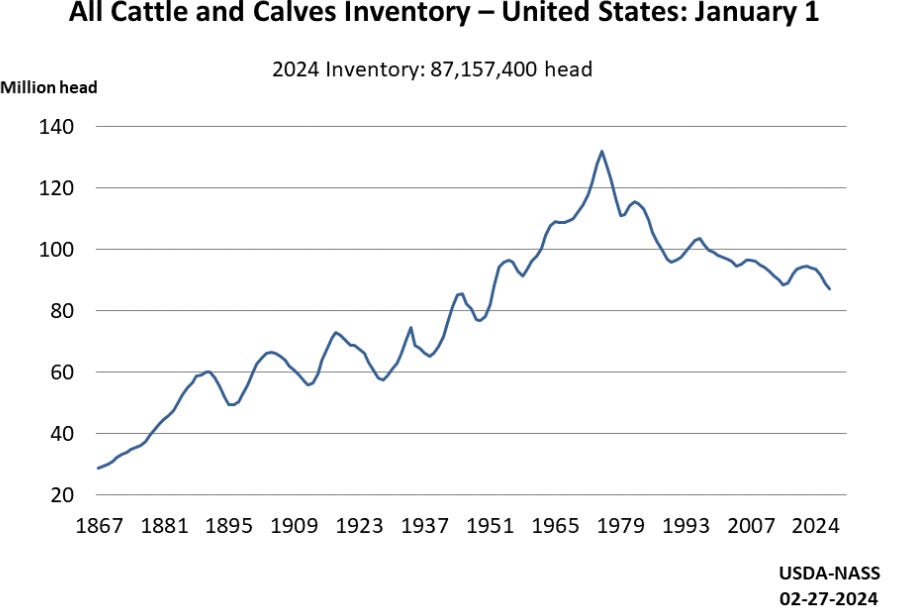
Recent reports show that the U.S. cattle herd continues to shrink. On its own, that might sound like a routine agricultural cycle — something that rises and falls with weather or markets. And to a degree, that’s true. Agriculture has always moved in seasons and cycles.
But what we’re seeing now reflects something deeper. The numbers are not just responding to one bad year or one dry spell. They are part of a longer pattern, 50 years and more — one shaped by land access, water availability, and the growing competition for both.
This isn’t about beef disappearing tomorrow. It’s about understanding the direction we’re heading, and why paying attention now is critical.
For many years, the assumption was simple: if demand rises, production will follow. Farmers and ranchers would adapt, expand, and respond. That model worked when land was accessible, water was reliable, and long-term planning was possible.
Today, those conditions are different and still declining.
Across much of the country — especially in fast-growing states — water has become the limiting factor. Land can still exist on paper, though eminent domain controls much of what landowners can use it for, and, without dependable water, it can no longer function the way it once did. Ranchers can’t maintain herds without certainty. Farmers can’t plan seasons when access changes year to year.
When water becomes uncertain, production doesn’t collapse all at once. It shrinks without transparency. Herds are reduced. Fields are left fallow. Long-term investments are postponed. Over time, those individual decisions begin to show up in national totals as you can see in the chart below.
Urban growth plays a major role in this shift. Cities require more water every year, and that demand is constant. At the same time, new industrial users have entered the picture — facilities that operate around the clock and cannot tolerate interruption - and often, wrongly in my opinion, supersede human needs.
Modern infrastructure, including large (AI) data centers and energy-related facilities (CO2 pipelines in particular), often requires continuous cooling and very high quantity, long-term water guarantees. Once those commitments are made, that water is effectively removed from communities/the local system, even during drought.
When supplies tighten, agriculture is frequently hardest hit.
From a planning standpoint, that may seem reasonable. Reality is very different.
A rancher can’t simply “scale back” without consequences that last for years. Once breeding stock is sold, rebuilding takes time. A single reduction can echo through production for half a decade or more.
This is one reason recovery in agriculture is always slower than decline. Damage happens quickly. Repair takes time.
CO₂ pipelines add another layer that often goes unnoticed. These projects are usually discussed as climate or energy infrastructure, but on the ground they involve permanent easements, compression facilities, and continuous operations. Those systems rely on cooling — and cooling requires water, often drawn from the same aquifers that support farms and ranches. (Read more at What You Don’t Know about CO2 Pipelines.)
Because safety and pressure safety/stability are critical (breaches are deadly), industrial water access is typically treated as non-negotiable. That can place rural landowners, even urban communities, in a difficult position: their land remains private, but their ability to operate steadily erodes.
This is how land can be lost without ever being taken. (Eminent domain is another major hazard. Read Introducing Eminent Domain.)
Ownership remains, taxes remain, liability remains (though risk control may be out of the hands of landowners), but the ability to use the land as working land disappears. And once land stops producing food, it rarely returns to that purpose. (One example is that solar farms leach harmful items into soil that control whether something can be grown there.)
None of this happens through a single dramatic decision. It happens incrementally — one permit, one contract, one planning document at a time. Individually, each step may appears manageable. Collectively, they reshape entire regions. (The federal government owns about 640 million acres—roughly 28% of all land in the U.S. State and local governments own land too. You can see this means all that land is unavailable to citizens. If you want to know more, see Property Rights and Freedom.)
Every day more land and water is being diverted from people to government and big business. That’s why every moment matters.
When food production gives way to non-food uses of land and water, dependence steadily increases. It may build over time; that process is already well underway. Each year of inaction allows the problem to deepen, making recovery more difficult and more costly.
The encouraging part is this: acknowledging the problem NOW and taking action will make a difference.
No one should think there is a quick fix. Decades of actions cannot be undone in a single policy cycle. But action taken now — protecting working land, ensuring reliable water access for food production, and weighing infrastructure decisions honestly, making good decisions — can limit how far the decline goes before improvement begins.
Food security is not about panic or predictions of empty shelves. It has many working parts. A system with many independent producers, diverse regions, and stable land use is necessary.
When farms and ranches disappear, they don’t just take food with them. They take knowledge, continuity, and independence.
That’s why food security is ultimately a freedom issue.
A nation that cannot reliably feed itself becomes more vulnerable — not overnight, but with certainty. When land and water drift away from food production, the impact isn’t felt all at once. It shows up over decades - as we’re seeing, in higher costs, longer supply chains, and fewer options when disruption occurs.
Protecting the ability to grow food is inseparable from protecting the land and water that make it possible.
The time to steady the course is now. The challenges are real, and so is the opportunity to correct direction before losses become more harmful or permanent. Thoughtful decisions made today can preserve options for tomorrow — for families, for communities, and for the country as a whole.
Sometimes progress doesn’t come from dramatic change, but from choosing to pay attention and act promptly.
“The personal right to acquire property, which is a natural right, gives to property, when acquired, a right to protect, as a social right.”
-James Madison
Sources:
🔗 USDA NASS – United States Cattle Inventory Report (July 25, 2025)
https://www.nass.usda.gov/Newsroom/2025/07-25-2025.php
🔗 Printable USDA Report PDF for the July 25, 2025 Cattle Inventory
https://data.nass.usda.gov/Newsroom/printable/2025/07-25-2025.pdf
Additional coverage of the same numbers (not official USDA site but using USDA data):
🔗 “U.S. Cattle Inventory Reaches 94 million in July 2025” — farms.com
https://m.farms.com/ag-industry-news/u-s-cattle-inventory-reaches-94-million-in-july-2025-458.aspx
🔗 ClearPath – Carbon Dioxide Pipelines 101 (overview of CO₂ pipeline transport)
https://clearpath.org/tech-101/carbon-dioxide-pipelines-101/
This explains how CO₂ is transported and why it’s pressurized, which relates to why pipelines need continuous systems that can require cooling and water use.
🔗 UH study on CO₂ pipeline compression & cooling
https://www.uh.edu/energy/_docs/_papers-reports/co2-pipelines-explained.pdf
As always, do your own research and make up your own mind.
White paper on land and water rights: Property Rights and Freedom: A White Paper on America’s Disappearing Land
United we stand. Divided we fall. We must not let America fall.
VoteTexas.gov, https://www.votetexas.gov/get-involved/index.html
Disclaimer:
As always, do your own research and make up your own mind. This Substack is provided for informational and commentary purposes only. All claims or statements are based on publicly available sources and are presented as analysis and opinion, not legal conclusions.
No assertion is made of unlawful conduct by any individual, company, or government entity unless such claims are supported by formal public records or verified legal documents. The views expressed here reflect my personal perspective on property rights and land use issues.
While I strive for accuracy and transparency, readers are encouraged to verify all details using the official sources and references provided. Any references to third-party material are included solely for your consideration and do not necessarily reflect my views or imply endorsement.
If you share this content, please include this disclaimer to preserve context and clarity for all readers.
Until next time…
Please share your thoughts in the comments. Or email me, and let’s have a problem-solving conversation. I welcome ‘letters to the editor’ type emails and may publish yours. I hope we can create a caucus with positive, back-to-the-founders’-dream-for-America results. Have a topic you want to know more about?
Some housekeeping…
Going forward, you may need to check your spam folder. And please mark this address as ‘not spam.’ If the newsletter isn’t in your spam folder either, you should look in the Promotions tab.
You can always see everything on the website, RationalAmerican.org.
Thanks again for reading! I’m glad you’re here!
Great analysis, Ellen!