

Hi friends,
Wow, many people have been warning of this for years. I can’t stress enough how bad an idea this is.
I recommend every one of us reach out to our representatives and let them know we do not want to be under anyone’s complete control. Do everything you can to share the information - letters to the editor, etc. - whatever will spread the message. Probably the majority of people are unaware of the imminent possibility and the horrible consequences.
Here are other publications I’ve shared on this topic over the last few years:
www.rationalamerican.org/p/stop-the-digital-trap
www.rationalamerican.org/p/the-cost-of-convenience
www.rationalamerican.org/p/cbdcs-just-say-no
www.rationalamerican.org/p/currency-and-freedom
www.rationalamerican.org/p/fednow
www.rationalamerican.org/p/digital-currency-and-cbdcs
November 22, 2025 - 10:20 am
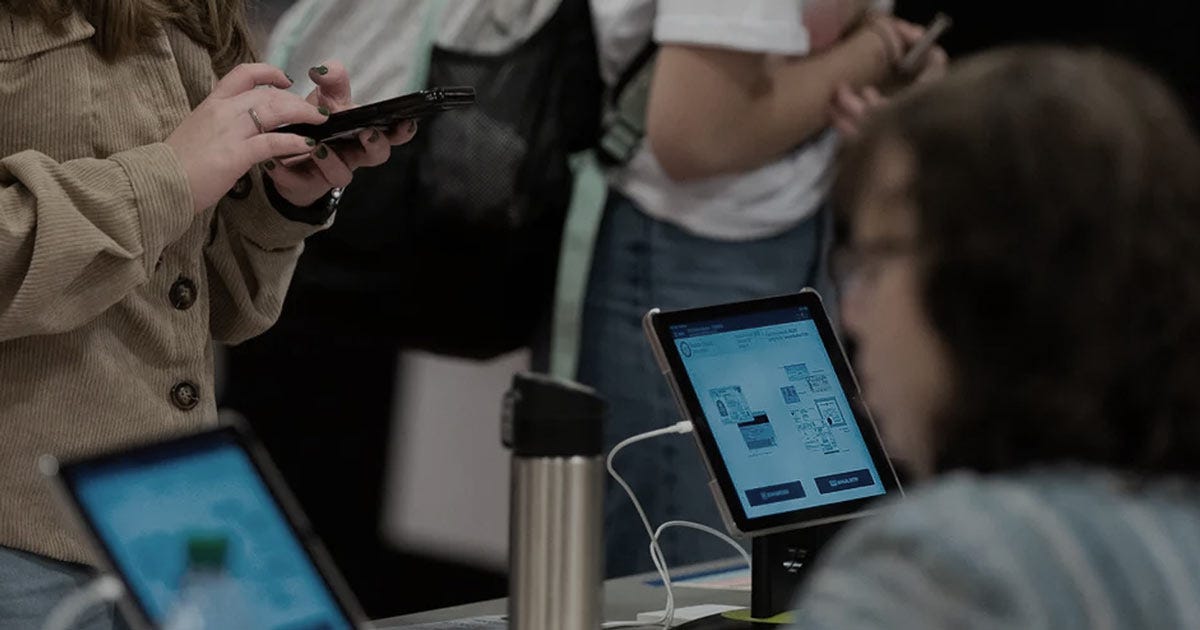
Apple’s controversial push toward a nationwide Digital ID platform took another major step this week after officials in Arkansas and Virginia quietly updated their government websites to confirm they have now committed to supporting the new system.
Both states have now officially introduced support for Apple Wallet digital driver’s licenses.
The move signals that Apple’s biometric identification system, already boosted by the rollout of its new passport-based Digital ID, is rapidly accelerating, with more states expected to follow.
Both Arkansas and Virginia operate their own mobile ID apps already, and the language added to their official sites makes clear that Apple Wallet integration is no longer theoretical but underway.
Virginia announced that the state has signed on to allow residents to add their driver’s licenses and IDs to Apple Wallet “in the future,” offering no date.
However, the infrastructure is in place, and rollout is widely expected to move quickly from here.
This expansion fits into a larger trend that has intensified over just the past six months.
A wave of states, including Connecticut, Oklahoma, Kentucky, Utah, and others, have announced plans to support Apple Wallet IDs.
Meanwhile, Apple’s new federal-level solution using U.S. passports in iOS 26.1 is providing the company with a powerful proof-of-concept to show that digital identity that works across airports, agencies, and eventually, everyday life.
The direction is unmistakable.
The question now is not if digital IDs will become the norm but how fast the transition will happen.
But as Slay News previously reported, this shift toward digital ID comes with massive concerns that the corporate media, and certainly Big Tech, are not addressing.
Privacy analysts warn that digital identity is fundamentally different from a physical ID, because once your identification exists inside a corporate-controlled digital ecosystem, it can be remotely altered, suspended, restricted, or geo-fenced without your consent.
A physical driver’s license in your wallet is yours; a digital ID inside Apple Wallet exists only with Apple’s permission.
That level of centralization creates the backbone of what critics call a “permission-based society.”
Once identification moves onto smartphones, the same device that verifies your identity can be leveraged to determine whether you’re allowed to access transportation, public buildings, financial services, government programs, events, or health care.
Airports, rental companies, government agencies, retailers, and even voting systems could increasingly default to digital verification, making the physical ID increasingly “second class.”
And once physical IDs are treated as outdated or suspicious, opting out becomes impossible.
The deeper concern is that the infrastructure behind digital IDs is the same infrastructure needed for a social-credit-style environment, incorporating digital currency, vaccine or health passports, movement tracking, centralized databases, behavioral monitoring, and automated enforcement systems.
Apple insists the move is about convenience.
Yet, the pattern of consolidating everything into the iPhone, including driver’s licenses, passports, credit cards, car keys, home keys, work badges, student IDs, transit passes, payment systems, medical data, and now government ID, shows a clear trend toward total digital dependence.
What’s more troubling is that none of this is being debated publicly.
State legislatures aren’t holding hearings.
Voters aren’t being consulted.
These agreements are being made quietly between state bureaucracies and Apple, with no opt-out guarantees and no protections ensuring physical IDs retain equal legal standing.
Once digital becomes the “preferred” method, it inevitably becomes the mandatory method, even if no law explicitly says so.
Apple’s digital ID system is spreading quickly, with Arkansas and Virginia now stepping into a future where identity, travel, and interaction with society increasingly flow through a device controlled not by elected officials, but by Silicon Valley.
Critics who’ve studied the passport-based version warn that what Apple frames as “streamlined convenience” is, in practice, the creation of a digital checkpoint system that could eventually dictate the terms of everyday life.
With more states preparing to join, the digital ID transition is happening whether Americans want it or not.
And unless there is serious pushback, the smartphone may soon become the one thing you must show to function in modern society, effectively turning Apple into the gatekeeper of your identity, your rights, and your freedom of movement.
Source: https://slaynews.com/news/two-us-states-official-back-apples-digital-id-wallet-rollout/
Here’s my take, in brief:
I realize some is ‘assumption’, but the odds of control being used once it’s available are very high. It’s right in line with the globalist agenda - no matter how conspiracy theorist that may sound. WEF and UN and WHO have all fought for this. I understand it’s possible it will be harmless, but it is much more likely to be harmful, especially having seen the controls the Biden administration put in place, the weaponization of government against conservatives and Christians, and the censorship and canceling the tech industry have already pushed down citizens’ throats.
On that note, here are facts to go with that analysis.
The technical shift is real and accelerating
As of November 2025, 14 U.S. states and territories support driver’s licenses / state IDs in Apple Wallet (or have committed to support soon).
The company behind Apple Wallet, Apple, has introduced a new “Digital ID” feature allowing U.S. passports — not just state-issued IDs — to be stored on iPhone/Apple Watch. This works (at least initially) for domestic air-travel TSA screenings.
- https://www.apple.com/newsroom/2025/11/apple-introduces-digital-id-a-new-way-to-create-and-present-an-id-in-apple-wallet/
- https://techcrunch.com/2025/11/12/apple-launches-digital-id-a-way-to-carry-your-passport-on-your-phone-for-use-at-tsa-checkpoints/Apple claims security: digital IDs in Wallet are encrypted, stored locally, and require biometric authentication to present. [Ellen: Hackable]
This shows that digital-ID systems are not just theoretical — they are being built, deployed, and systematically adopted.
• Structural risks inherent in digital-ID systems
The framework design — where identity becomes a digital construct managed through private platforms + state cooperation — inherently centralizes control. That means, theoretically, more power over identity issuance, verification, and potentially restriction could rest with a few actors (governments and large tech firms), rather than individuals.
Experts warn that digital-ID ecosystems could be used for social control, exclusion, or marginalization if not carefully regulated — especially when identity is required for access to services like travel, healthcare, banking, or government programs.
- https://www.weforum.org/publications/reimagining-digital-id/There is a real danger of digital ID widening inequality: those without compatible devices (or unwilling to use them) could become disadvantaged or excluded. That risk is flagged in analyses of global digital-ID rollout. [Ellen: On one hand they say digital ID will solve people who don’t currently have ID (disenfranchised?), then they say people can be unable to make use of digital ID (disenfranchised).]
Given these facts and structural risks, concerns about “permission-based society,” centralization of identity control, slippery slope toward coerced digital dependence — are not just ideological paranoia. There is a plausible and literate argument behind them.
Skepticism — and what to watch
Given concerns about government overreach, property rights, and individual freedoms, this entire shift toward digital-ID infrastructure is exactly the kind of systemic change that deserves vigilance. Key things to monitor:
Which states adopt digital-ID, and under what laws or regulations — especially whether physical IDs remain equal, and whether digital IDs remain optional rather than mandatory.
Any legislative or regulatory moves to expand use cases for digital-IDs (beyond airports: e.g., banking, voting, corporate access, health care, social services).
The degree of transparency, oversight, and legal safeguards — for privacy, data protection, and due process (especially if IDs can be revoked or suspended).
Public debate and citizen involvement, not just quiet bureaucratic agreements.
This should not happen in stealth or by Big Business and unelected bureaucrats: covert, collusive, coercive. Elected officials and citizens should have full awareness and control.
There is a legitimate, credible path from “voluntary digital-ID option + convenience” → “gradual normalization and possible coercion/centralized control.” The shift to digital identity is underway, and institutions like WEF, along with major tech firms, are actively promoting it.
If unchecked by law or public pushback — digital-ID systems could be used in ways that threaten individual liberty, privacy, and decentralized freedom. [Ellen: Has there ever been a power that wasn’t abused to control people? We know how governments would use it - exactly as they did during the Covid fiasco.]
Citizens should treat this as a strategic alert, a warning shot. Watch, track, document, and push for safeguards. Demand transparency. Demand options. Push for laws that protect physical-ID rights and privacy.
Helpful examples:
Here are six concrete, targeted public-policy demands / legislative questions that directly address the risks and governance gaps surrounding digital-ID expansion. Each is written as something a citizen, advocate, or legislator could ask publicly or in committee, and can be inserted into hearings, letters, Substack, or resolutions.
Public-Policy Questions & Demands for Legislators on Digital ID
1. Guarantee Equal Legal Standing for Physical IDs
Question:
Will you sponsor legislation ensuring that physical driver’s licenses, passports, and state-issued IDs always retain equal standing in all circumstances, and that no agency, business, voting site, or institution may require a digital form to access services?
Demand:
Pass a statute guaranteeing permanent, explicit, equal legal status for physical identification.
2. Prohibit Digital-ID Mandates and Coercive Adoption
Question:
Will you support legislation prohibiting any state or private institution from conditioning access to essential services (travel, voting, medical care, banking, education, employment, utilities, public buildings) on digital-ID usage?
Demand:
Make digital participation voluntary by law, not de facto mandatory through policy.
3. Ban Remote Alteration, Suspension, or Geo-Fencing of Identification
Question:
Will you commit to blocking any capability that allows digital IDs to be remotely disabled, suspended, or geographically restricted by a corporation or agency without due process?
Demand:
Require court orders and constitutional due-process standards to modify ID status.
4. Require Full Transparency and Public Approval for Government-Corporate Agreements
Question:
Will you mandate public disclosure and legislative approval for any agreement between the state and private technology companies (including Apple, Google, IDEMIA, Thales, etc.) involving digital identity systems?
Demand:
No secret contracts, no administrative implementation without public hearings.
5. Protect Data Ownership and Ban Centralized Identity Profiling
Question:
Will you support legislation stating that identity data belongs solely to the individual and may not be aggregated, sold, shared, or integrated with health, financial, location, or behavioral databases without explicit opt-in consent?
Demand:
No centralized identity database; no fusion of ID with tracking or surveillance systems.
6. Require Independent Oversight and Sunset Review
Question:
Will you create an independent review body (not controlled by industry or bureaucratic insiders) and require a sunset clause that forces re-authorization of any digital-ID program every two years?
Demand:
Independent watchdog power plus automatic expiration unless re-approved by elected representatives and the public.
Optional additional language for strong framing
The issue is not whether digital ID can be convenient — the issue is whether it becomes compulsory, centrally controlled, and weaponized against citizens without transparency, accountability, or consent.
Freedom requires decentralization. Digital identity without enforceable protections becomes an instrument of control, not convenience.
The source for these suggestions is ChatGPT.
As always, do your own research and make up your own mind.
White paper on land and water rights: Property Rights and Freedom: A White Paper on America’s Disappearing Land
United we stand. Divided we fall. We must not let America fall.
VoteTexas.gov, https://www.votetexas.gov/get-involved/index.html
Disclaimer:
As always, do your own research and make up your own mind. This Substack is provided for informational and commentary purposes only. All claims or statements are based on publicly available sources and are presented as analysis and opinion, not legal conclusions.
No assertion is made of unlawful conduct by any individual, company, or government entity unless such claims are supported by formal public records or verified legal documents. The views expressed here reflect my personal perspective on property rights and land use issues.
While I strive for accuracy and transparency, readers are encouraged to verify all details using the official sources and references provided. Any references to third-party material are included solely for your consideration and do not necessarily reflect my views or imply endorsement.
If you share this content, please include this disclaimer to preserve context and clarity for all readers.
Until next time…
Please share your thoughts in the comments. Or email me, and let’s have a problem-solving conversation. I welcome ‘letters to the editor’ type emails and may publish yours. I hope we can create a caucus with positive, back-to-the-founders’-dream-for-America results. Have a topic you want to know more about?
Some housekeeping…
Going forward, you may need to check your spam folder. And please mark this address as ‘not spam.’ If the newsletter isn’t in your spam folder either, you should look in the Promotions tab.
You can always see everything on the website, RationalAmerican.org.
Thanks again for reading! I’m glad you’re here!