

Hi friends,
Three stories caught my attention this week that, at first glance, seem to have almost nothing to do with one another.
One is about Canada’s weak economic performance. One is about Iran, oil exports and the Strait of Hormuz. The third concerns federal sanctions against infrastructure supporting violent far-left groups.
But put them next to each other and a larger idea begins to emerge: national strength is not just military strength. It includes a productive economy, abundant and reliable energy, manufacturing capacity, secure supply chains, financial and technological infrastructure, and institutions strong enough to protect both constitutional rights and the rule of law.
Those pieces reinforce one another.
And I bet that sounds familiar to you. We have been hearing these things, haven’t we?
Canada: Economic policy shows up in the numbers
A recent Elizabeth Nickson column drew attention with the headline “U.S. median income $90K, Canadian $60K.” That particular comparison needs caution because the underlying income measures are not necessarily apples-to-apples. But the larger point she was making is much harder to dismiss: Canada has been struggling economically.
A chart accompanying the piece placed Canada at the bottom of a group of advanced economies for cumulative real GDP growth from early 2025 to early 2026. The exact figure in that graphic appears to depend on the particular data release being used, but subsequent OECD figures confirm the basic story. Canada’s economy contracted 0.2% in the fourth quarter of 2025 and showed no growth in the first quarter of 2026. Compared with a year earlier, Canadian GDP was down 0.1% — the weakest result among the G20 economies for which the OECD reported data. (The White House)
Why does that matter to Americans?
Because economic policy is not simply about this quarter’s GDP number or whether the stock market went up yesterday. Productivity, investment, energy availability, regulation, housing, workforce growth and the ability to build things all accumulate over time. Eventually, the effects show up in wages, purchasing power, business formation and living standards.
And ultimately, a country with a stronger productive base has greater freedom of action. It has more resources available for infrastructure, defense, innovation and emergencies.
A country that has lost manufacturing capacity, become overly dependent on foreign suppliers, or allowed its productive base to flounder becomes weak: prosperity cannot simply be taken for granted. It has to be produced.
Iran: Energy is economic power — and strategic power
Then there is Iran.
The current struggle over the Strait of Hormuz makes the relationship between energy and national security especially visible.
Iran has long possessed enormous leverage because of its geography, and no one had challenged that status quo until recently. The Strait is one of the world’s most important energy chokepoints (or was), and threatening shipping through it can raise oil prices and impose costs far beyond the Middle East.
So the pressure cuts both ways.
The disruption is certainly not painless for everyone else. Shipping remains dangerous, tankers have been attacked and oil prices have risen. Iran can still impose substantial costs.
But this is also a real-world demonstration of why energy production, refining, transportation, manufacturing and supply chains matter so much.
A country that can produce more of what it needs — energy, equipment, critical materials, replacement parts — is harder to squeeze.
A country that depends heavily on one export, one route, one foreign supplier or one vulnerable link in a supply chain has less room to maneuver.
That is why current U.S. policy increasingly treats supply chains as a national-security issue. A July executive order directs defense contractors to map critical supply chains all the way back to raw materials, identify bottlenecks and single points of failure, and shift important sourcing toward the United States or allied nations where possible.
That may sound like dry government policy until a war, blockade, pandemic or other crisis suddenly makes one missing component very important.
Then everybody understands supply chains.
Political violence: Constitutional liberty requires constitutional order
The third story, from Real Clear Politics, looks completely different.
On August 26, the Treasury Department sanctioned the Italy-based Autistici/Inventati collective, saying it supplied specialized digital infrastructure, tools and services to Antifa cells and other violent far-left extremist organizations. Treasury used its counterterrorism authorities to target the organization and several other groups it said provided support to violent networks. (U.S. Department of the Treasury)
There will inevitably be arguments about where government authority should begin and end in this area, and there should be. Powerful counterterrorism authorities deserve scrutiny.
But one distinction should not be difficult.
The First Amendment protects speech, political disagreement and peaceable assembly. Political violence does not become constitutionally protected merely because someone calls it protest.
Arson is not speech. Assault is not assembly. Sabotage is not petitioning the government for redress of grievances.
And organized political violence does not have to resemble a traditional organization with officers, membership cards and a headquarters. Opposing networks, usually extremists, provide money, technology, communications, logistics, training, information or other support. Treasury’s latest action is important partly because it focuses on that supporting infrastructure rather than treating every violent incident as a one-off.
A free society has to be able to do two things simultaneously: protect the right of citizens to criticize their government — vigorously, angrily and publicly — and enforce the boundary where political expression becomes violence or material support for violence.
Failing at either one weakens America.
The larger picture
An overview of these three stories can be summed up like this.
A prosperous nation needs the economic capacity to produce wealth rather than simply consume it.
A secure nation needs energy, manufacturing, supply chains and infrastructure resilient enough to withstand pressure from abroad.
And a free nation needs institutions capable of protecting peaceful political disagreement while enforcing laws against political violence.
That helps explain why policies concerning energy production, domestic manufacturing, critical minerals, defense supply chains, grid reliability and technological infrastructure increasingly appear alongside one another. They may look like separate policy debates, but are really pieces of the same question:
How much capacity does America have to take care of itself when conditions become difficult?
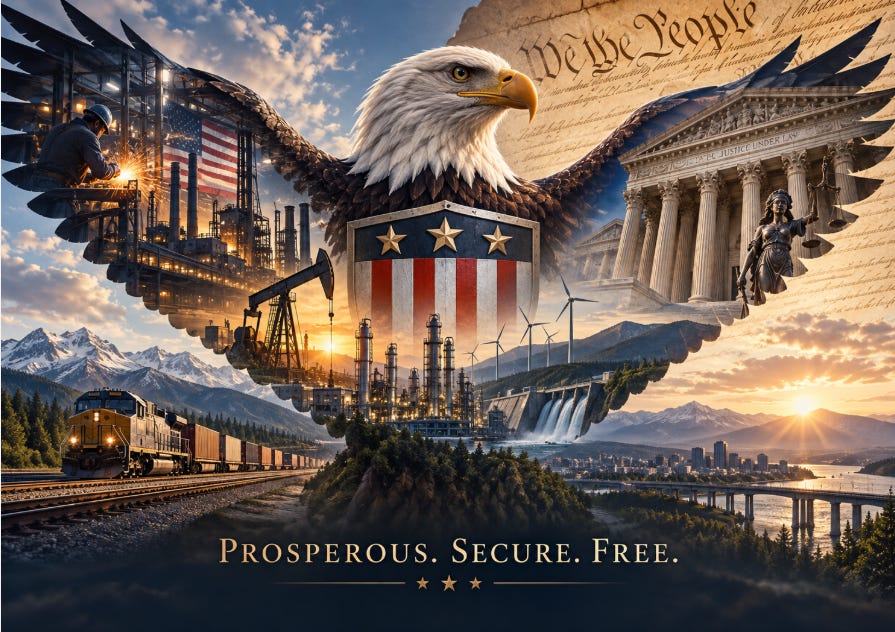
Economic policy matters. Energy policy matters. The rule of law matters. And none of them exists in isolation from America’s ability to remain prosperous, secure and free.
Sources:
“U.S. Median Income $90K, Canadian $60K”
(Elizabeth Nickson)“Time Is No Longer on Iran’s Side in the Battle of the Blockades”
GDP, Income and Expenditure, First Quarter 2026
(Statistics Canada)“Blockade succeeds where sanctions failed as Iran oil exports stall”
(Reuters)“Iran’s Hormuz leverage wanes as US economic squeeze bites”
(Reuters)Securing America’s Defense Supply Chains and Ensuring Domestic Acquisition of Critical Materials (The White House)
Large-Scale Energy and Energy-Related Infrastructure
(The White House)Domestic Petroleum Production, Refining and Logistics Capacity
(The White House)Grid Infrastructure, Equipment and Supply Chain Capacity
(The White House)August 26 sanctions action involving A/I Collective and violent far-left networks (U.S. Treasury Department)
As always, do your own research and make up your own mind.
White paper on land and water rights: Property Rights and Freedom: A White Paper on America’s Disappearing Land (8/13/2025)
United we stand. Divided we fall. We must not let America fall.
VoteTexas.gov, https://www.votetexas.gov/get-involved/index.html
Disclaimer:
As always, do your own research and make up your own mind. This Substack is provided for informational and commentary purposes only. All claims or statements are based on publicly available sources and are presented as analysis and opinion, not legal conclusions.
No assertion is made of unlawful conduct by any individual, company, or government entity unless such claims are supported by formal public records or verified legal documents. The views expressed here reflect my personal perspective on property rights and land use issues.
While I strive for accuracy and transparency, readers are encouraged to verify all details using the official sources and references provided. Any references to third-party material are included solely for your consideration and do not necessarily reflect my views or imply endorsement.
If you share this content, please include this disclaimer to preserve context and clarity for all readers.
Until next time…
Please share your thoughts in the comments. Or email me, and let’s have a problem-solving conversation. I welcome ‘letters to the editor’ type emails and may publish yours. I hope we can create a caucus with positive, back-to-the-founders’-dream-for-America results. Have a topic you want to know more about?
Some housekeeping…
Going forward, you may need to check your spam folder. And please mark this address as ‘not spam.’ If the newsletter isn’t in your spam folder either, you should look in the Promotions tab.
You can always see everything on the website, RationalAmerican.org.
Thanks again for reading! I’m glad you’re here!
Thank you for this very well written article