

Hi friends,
There’s a growing sense—understandably so—that the world is moving toward something bigger, more centralized, and potentially more controlling. You hear it in discussions about BRICS, global finance, digital currencies, supply chains, and even land and infrastructure here at home. It can feel like the pieces are being assembled into something that ordinary people will have very little control over.
But let’s look at what’s happening in a more grounded—and importantly, more hopeful way.
Yes, the world is changing.
No, the outcome is not predetermined.
The Big Concern: A Consolidated Global Power Structure
Some of today’s anxiety centers on the idea that a bloc of nations—often associated with BRICS—could eventually form a counterweight powerful enough to reshape global systems.
At the center of that concern is China.
China is not just another economic competitor. It is strategic, disciplined, and long-term in its planning. Its leadership structure allows it to move with a level of coordination that democracies often struggle to match. Through infrastructure investments, trade networks, and regional partnerships, it has been steadily expanding its influence across Asia, Africa, and parts of Europe.
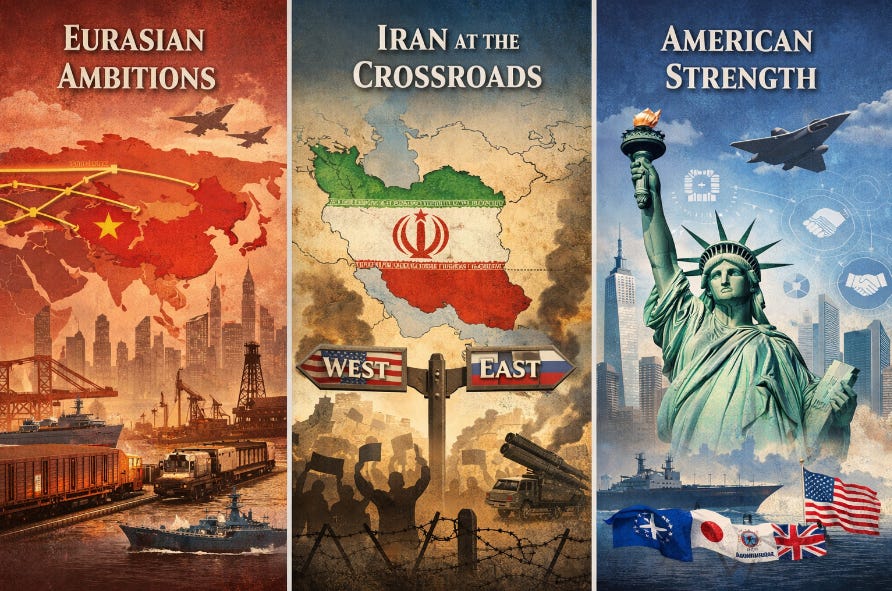
That’s where the idea of “Eurasian consolidation” comes in—the possibility that China could anchor a vast, interconnected economic and political system stretching across Europe and Asia.
If that were to fully materialize, it could shift the balance of global power in a profound way.
But here’s the key point that often gets lost:
That consolidation is far from inevitable. I submit that with President Trump’s current handle on the global situation things will become even more stable, and America’s strength will continue to increase.
What the Headlines Don’t Always Tell You
It’s easy to look at maps, alliances, and headlines and think certain outcomes are likely. But geopolitics is more complex than that.
China, for all its strength, is also facing internal pressures—economic slowdowns, demographic challenges, and structural issues that could limit its long-term trajectory.
Russia, often seen as part of a competing bloc, is not in a position of strength. Its ongoing conflicts have drained resources and increased its dependence on China rather than reinforcing independence.
And then there is Iran—arguably one of the most important and unpredictable players in the current landscape.
Iran sits at a literal and strategic crossroads. It connects regions, influences energy flows, and shapes Middle Eastern stability. But its future is not locked in. Internal pressures, generational shifts, and geopolitical realities mean that Iran could move in a very different direction in the near future.
That uncertainty matters. And, thinking positively, the U.S. will continue to hold control of the Strait of Hormuz.
And let us not forget Indonesia’s Strait of Malacca. Another strengthening step for America.
This is Important for Sovereignty and Everyday Americans
At first glance, these global shifts might feel distant—something for diplomats and defense analysts to debate. But they connect directly to the issues many of us have been following closely:
Who controls land
Who controls resources
Who sets the rules for infrastructure and development
Who ultimately decides how communities grow—or don’t
When power consolidates—whether globally or domestically—it often leads to the same outcome: less local control, fewer choices, and more top-down decision-making.
We’ve seen versions of this already in:
Large-scale infrastructure planning that overrides local concerns
Resource allocation decisions that prioritize industrial or strategic use over community needs
Increasing alignment between government policy and large institutional interests
The global picture and the local picture are not separate. They are reflections of the same underlying question:
Who holds the power—and who gets a say?
The United States: Not Declining, Reawakening
Some want to believe that the United States is in decline.
That narrative doesn’t hold up.
The U.S. remains:
The world’s leading economic and financial hub
A dominant force in technological innovation
Energy independent in ways that were unthinkable just decades ago
Anchored by longstanding alliances that still matter
But strength alone isn’t enough. Strategic action is critical. Citizen engagement is required.
A Realistic Path Forward
Strengthening alliances—not abandoning them
Longstanding partnerships still provide stability and shared leverage. Walking away from them would create more risk, not less.
Selective engagement—even with adversaries
Diplomacy is not weakness. Strategic engagement, when done carefully, can prevent larger conflicts and shift long-term alignments.
Avoiding unnecessary wars
Especially in regions like the Middle East, where escalation can spiral quickly and unpredictably.
Maintaining economic and technological leadership
This is where long-term influence is truly built—not just on the battlefield, but through innovation, production, and financial systems.
And increasingly, there is another piece worth noting:
Peace-making efforts.
The last 15 months have seen a number of diplomatic agreements and normalization efforts in historically unstable regions. While each one is complex and imperfect, they point toward something important:
Peace is still possible—even in places long defined by conflict.
Where This Leaves Us
It’s natural when we look at the complexity of today’s world we feel uncertain. Life is always uncertain. We just aren’t always facing that fact head-on.
The direction of the future is still being shaped—by decisions, by leadership, and yes, by informed citizens who are paying attention.
The world is not settling, and never will, into a fixed order.
And that means the work of protecting freedom, strengthening communities, and addressing issues is never-ending.
That means staying engaged, staying informed, and continuing to work .
As always, do your own research and make up your own mind.
White paper on land and water rights: Property Rights and Freedom: A White Paper on America’s Disappearing Land
United we stand. Divided we fall. We must not let America fall.
VoteTexas.gov, https://www.votetexas.gov/get-involved/index.html
Disclaimer:
As always, do your own research and make up your own mind. This Substack is provided for informational and commentary purposes only. All claims or statements are based on publicly available sources and are presented as analysis and opinion, not legal conclusions.
No assertion is made of unlawful conduct by any individual, company, or government entity unless such claims are supported by formal public records or verified legal documents. The views expressed here reflect my personal perspective on property rights and land use issues.
While I strive for accuracy and transparency, readers are encouraged to verify all details using the official sources and references provided. Any references to third-party material are included solely for your consideration and do not necessarily reflect my views or imply endorsement.
If you share this content, please include this disclaimer to preserve context and clarity for all readers.
Until next time…
Please share your thoughts in the comments. Or email me, and let’s have a problem-solving conversation. I welcome ‘letters to the editor’ type emails and may publish yours. I hope we can create a caucus with positive, back-to-the-founders’-dream-for-America results. Have a topic you want to know more about?
Some housekeeping…
Going forward, you may need to check your spam folder. And please mark this address as ‘not spam.’ If the newsletter isn’t in your spam folder either, you should look in the Promotions tab.
You can always see everything on the website, RationalAmerican.org.
Thanks again for reading! I’m glad you’re here!