

Hi friends,
The Supreme Court’s 2025-26 term began in early October, and although the Court receives more than 7,000–8,000 requests for review every year, it typically agrees to hear only 80–100 cases, guided by the Rule of Four — meaning four justices must vote to take up a case. The Court chooses cases involving constitutional questions, major national impact, or where lower courts have split and need a definitive resolution. The term runs October–June, not the calendar year, and decisions often cluster between March and the end of June.
Because acceptance is rare, any case SCOTUS agrees to hear — especially one involving constitutional structure, executive power, or individual rights — is automatically high-stakes.
Most Americans won’t hear much about these cases. Instead, they’ll hear about protests, personalities, and political theater. But this year’s docket contains something far more important:
Cases that could completely reshape how America is governed — and who actually holds power.
This is not a routine term. This is a constitutional turning point.
The theme running through nearly all of the major cases is simple:
Will power be restored to elected leaders — or continue shifting toward unelected agencies and courts?
This Court may be facing some of the most consequential structural cases in decades — defining who controls the federal government itself.
Depending on rulings in spring and summer, agency power, presidential power, and congressional power may be rewritten.
With that in mind, the list below is a current “snapshot” of major 2025–26 cases granted to date — including a look at some that might define this Court’s legacy. Will executive powers be less hindered? Will the administrative state return to checks and balances?
Note: Everywhere President Trump’s name appears really means *THE* president. These cases have mostly come about because of Trump’s agenda to Make America Great Again, but the rulings decide what authority any president has. Will it be the elected ‘leader’ of America, or will it be the puppet masters behind the scenes?
I. THE CENTERPIECE: REINING IN THE ADMINISTRATIVE STATE
For most of American history, citizens voted for leaders who would then run the government. Over the last century, that system quietly changed. Regulatory agencies — staffed by unelected officials — increasingly set national policy through rules, guidance, and enforcement decisions that carry the force of law.
Many Americans feel this shift even if they can’t name its cause.
This term, the Supreme Court is finally being asked to confront it directly.
The 1935 Decision That Changed American Government
In 1935, the Supreme Court issued Humphrey’s Executor v. United States, ruling that the President could not freely remove certain agency officials. That ruling helped create what we now call “independent agencies” — bodies that exercise executive power but are insulated from presidential control.
It was a dramatic structural shift.
Instead of government changing when voters elected new leaders, agency heads could remain in place — even when the public clearly demanded new direction. Over time, these agencies became what many scholars call:
“A fourth branch of government, not mentioned in the Constitution, and accountable to no one.”
Congress legislated less.
Presidents relied more on executive orders.
Agencies filled the vacuum — issuing tens of thousands of binding rules that touch nearly every part of American life.
This term, the Court will hear the most direct challenge to that structure in 90 years.
II. TRUMP v. SLAUGHTER — THE CASE THAT COULD RESET FEDERAL POWER
Case: Trump v. Slaughter
Issue: Presidential removal power over the Federal Trade Commission (FTC)
Oral Argument: December 2025
Source: https://www.dailysignal.com/2025/09/22/supreme-court-takes-case-reconsidering-major-precedent-protecting-deep-state/
Core Question
Can a president fire an FTC commissioner without having to meet narrow statutory conditions?
Why This Case Matters
If the Court overturns Humphrey’s Executor:
The President regains constitutional control over agencies
Commissioners become accountable to elections again
The administrative state loses its insulation
Regulatory power shifts back to branches the Constitution actually created
This could be the most consequential structural ruling since the New Deal era.
If the Court rules for Trump
Independent agencies lose “untouchable” status
Accountability returns to elected leadership
Presidents can finally direct the executive branch again
If the Court rules against Trump
Bureaucratic power remains above elections
Presidents remain figureheads on regulatory policy
Regulatory authority continues drifting away from voters
Slaughter is the structural case.
The next case is the real-world test.
III. BLANCHE v. PERLMUTTER — THE COMPANION CASE
Case: Blanche v. Perlmutter
Issue: Whether the President may remove an agency official at will
Status: SCOTUS denied emergency relief Nov. 26, 2025 (full review expected)
Source: https://thefederalist.com/2025/11/26/scotus-punts-on-trumps-firing-of-library-of-congress-official-for-now/
While Slaughter asks the big constitutional question, Perlmutter asks the commonsense one:
How can voters expect change if presidents cannot remove agency officials who oppose their policies?
This case shows the practical stakes.
If a President wins an election but cannot remove the very officials implementing (or resisting) policy, then the will of the people cannot shape government.
IV. EMERGENCY POWERS: THE IEEPA TARIFF CASE
This is the other major constitutional case of the term — not about agencies, but about executive authority.
Case Name: Pending formal name (widely known as the IEEPA Tariff Case)
Issue: Whether President Trump exceeded authority under the International Emergency Economic Powers Act (IEEPA)
Oral Argument: November 5, 2025
Source: https://www.theepochtimes.com/article/as-supreme-court-set-to-return-what-to-expect-in-trump-cases-5913105
Core Question
Can the President use emergency economic powers — including tariffs — without Congress’s approval?
Why This Matters
This case decides whether the President retains flexibility to respond quickly to:
hostile foreign trade practices
national security threats
supply-chain disruptions
geopolitical pressure
If the Court rules for Trump
Emergency authority broadens
Economic measures (like tariffs) remain usable in crises
Executive agility in foreign affairs is strengthened
If the Court rules against Trump
Emergency powers narrow significantly
Presidents must seek congressional approval for future tariff actions
National security responses may slow during crises
Executive power resets to a pre–World War II model
Many Court-watchers see the IEEPA case and Slaughter as two sides of the same question:
Who governs — elected leaders or the unelected machinery surrounding them?
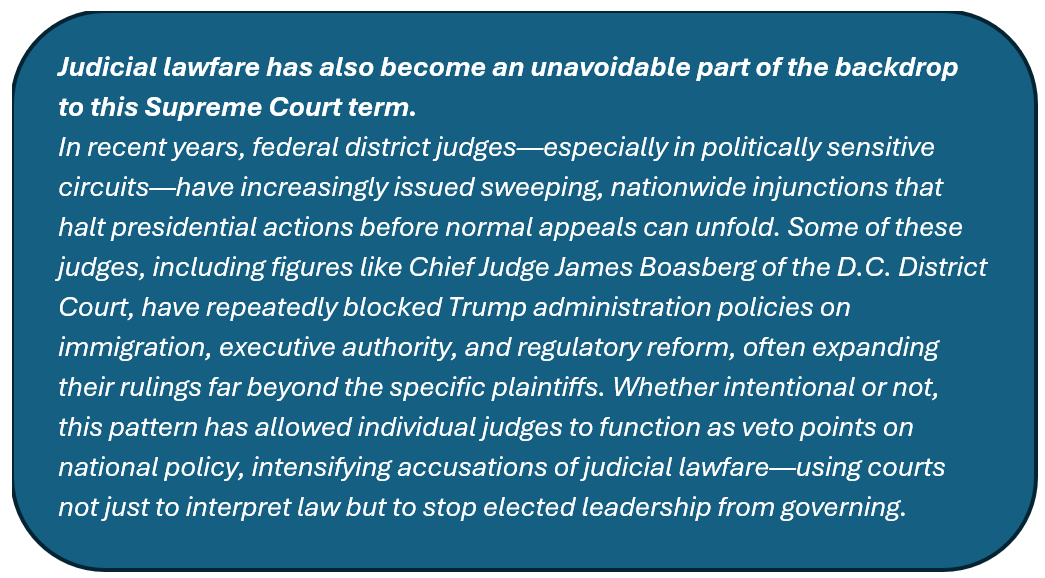
V. THE “SHADOW DOCKET” — A SHORT EXPLANATION
The phrase “shadow docket” is often used in media coverage as if it suggests secrecy. In reality, it simply means:
the Supreme Court’s emergency decision pathway.
Every administration — Republican and Democrat — uses it when lower courts issue nationwide injunctions blocking federal policies. The Trump administration has filed several such requests this term because district courts have frozen:
immigration enforcement measures
executive removal actions
economic orders (including tariffs)
national security directives
The Court must then decide:
Does the policy continue while litigation proceeds, or does one judge freeze national policy for months?
It’s not unusual.
It’s not new.
It’s not sinister.
It’s just part of the Court’s emergency function.
VI. TRUMP v. CASA — A DEFINING CASE ON BIRTHRIGHT CITIZENSHIP
Case: Trump v. CASA
Issue: Whether the 14th Amendment requires automatic citizenship for the children of illegal entrants and other non-jurisdictional foreign nationals
Arguments: Expected late December or early January
Source: https://www.theepochtimes.com/article/as-supreme-court-set-to-return-what-to-expect-in-trump-cases-5913105
The Constitutional Question
Does “subject to the jurisdiction” in the 14th Amendment mean:
Anyone physically present, or
Those who owe full legal allegiance to the United States?
The Supreme Court has never ruled on citizenship for the children of illegal entrants.
Wong Kim Ark (1898) involved lawful, permanent residents.
That means this case will answer a 150-year-old unresolved question.
If Trump prevails
Birthright citizenship changes for the first time in American history
Incentives for illegal entry shift
Congress may finally legislate
U.S. aligns more with global norms (most countries do not grant location-based citizenship)
If CASA prevails
The status quo continues
Courts, not Congress, define citizenship policy
Immigration incentives remain unchanged
This case is not simply about citizenship.
It’s about sovereignty, representation, and the meaning of belonging to a nation.
VII. THE THREE MOST CONSEQUENTIAL CASES OF THE TERM
1. Trump v. Slaughter — Agency Removal Power
Impact: Could overturn Humphrey’s Executor and return control of federal agencies to elected leadership.
2. The IEEPA Tariff Case — Emergency Powers
Impact: Determines whether presidents retain modern emergency authority in national security and economic crises.
3. Trump v. CASA — Birthright Citizenship
Impact: Clarifies the 14th Amendment and determines citizenship rules for the next century.
Together, these cases ask the same foundational question:
Does the Constitution still govern the federal government — or do agencies and courts now hold the real power?
VIII. WHY THIS TERM MATTERS MORE THAN MOST
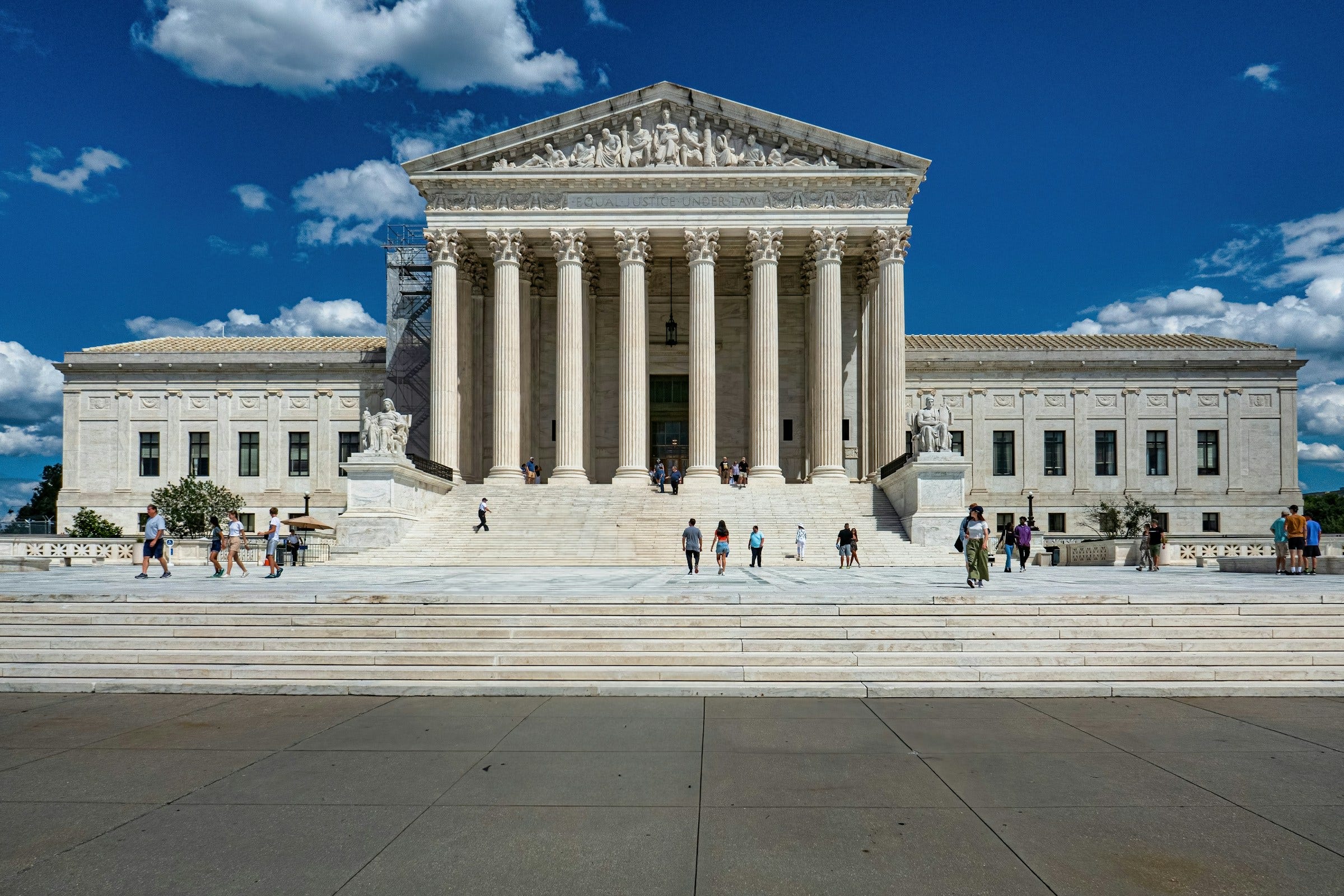
The Supreme Court is the only federal institution designed to be permanent.
Every other institution — Congress, the Presidency, federal agencies — exists only because the Constitution allows it.
This term, the Court is facing questions that go to the very heart of:
who governs
who is accountable
who interprets the Constitution
who runs the federal bureaucracy
and who counts as a citizen
The answers will shape the country for decades.
As one commentator recently observed:
Only the Supreme Court is constitutionally immortal. Every other federal institution is a legislative houseplant — Congress can water them, or not.
IX. CONCLUSION: A CROSSROADS FOR THE REPUBLIC
As of December 3, 2025, the Supreme Court’s 2025–26 docket contains cases that could:
redefine citizenship
reshape the administrative state
restore or restrict executive power
rebalance the separation of powers
and determine whether American government answers to voters or to career officials
Most terms develop the law. This term could redefine the system.
The Constitution is still working — but the question is for how long, and under whose authority.
Stay alert.
Stay engaged.
And don’t let the headlines drown out what truly matters.
Sources:
Daily Signal — Supreme Court Takes Case Reconsidering Major Precedent Protecting Deep State
https://www.dailysignal.com/2025/09/22/supreme-court-takes-case-reconsidering-major-precedent-protecting-deep-state/The Federalist — SCOTUS Punts on Trump’s Firing of Library of Congress Official—for Now
https://thefederalist.com/2025/11/26/scotus-punts-on-trumps-firing-of-library-of-congress-official-for-now/
The Epoch Times — As Supreme Court Set to Return, What to Expect in Trump Cases
https://www.theepochtimes.com/article/as-supreme-court-set-to-return-what-to-expect-in-trump-cases-5913105
Washington Examiner — Supreme Court Sitting on Four Emergency Requests From the Trump Administration
https://www.washingtonexaminer.com/news/supreme-court/3817988/supreme-court-sitting-on-four-emergency-requests-from-the-trump-administration/
As always, do your own research and make up your own mind.
White paper on land and water rights: Property Rights and Freedom: A White Paper on America’s Disappearing Land
United we stand. Divided we fall. We must not let America fall.
VoteTexas.gov, https://www.votetexas.gov/get-involved/index.html
Disclaimer:
As always, do your own research and make up your own mind. This Substack is provided for informational and commentary purposes only. All claims or statements are based on publicly available sources and are presented as analysis and opinion, not legal conclusions.
No assertion is made of unlawful conduct by any individual, company, or government entity unless such claims are supported by formal public records or verified legal documents. The views expressed here reflect my personal perspective on property rights and land use issues.
While I strive for accuracy and transparency, readers are encouraged to verify all details using the official sources and references provided. Any references to third-party material are included solely for your consideration and do not necessarily reflect my views or imply endorsement.
If you share this content, please include this disclaimer to preserve context and clarity for all readers.
Until next time…
Please share your thoughts in the comments. Or email me, and let’s have a problem-solving conversation. I welcome ‘letters to the editor’ type emails and may publish yours. I hope we can create a caucus with positive, back-to-the-founders’-dream-for-America results. Have a topic you want to know more about?
Some housekeeping…
Going forward, you may need to check your spam folder. And please mark this address as ‘not spam.’ If the newsletter isn’t in your spam folder either, you should look in the Promotions tab.
You can always see everything on the website, RationalAmerican.org.
Thanks again for reading! I’m glad you’re here!