

Hi friends,
This is one more story of President Trump taking action with the intent to protect America and Americans as well as basically following the Monroe Doctrine of protecting the Americas (this hemisphere).
Of course there are the usual naysayers, those who do not have America’s interests at heart or are actual enemies of America.
I also want to take this opportunity to say that it is beyond sad that opponents of President Trump and enemies of America use inflammatory rhetoric to stir dissent and cause tragic events like Charlie Kirk’s assassination and the death of Nicole Renee Good.
Keep it simple. Judeo-Christian Values. Know Your Rights. Preserve the principles of the United States Constitution. Protect the First Amendment. Citizens' voting rights. Capitalism.
No one person is all right or all wrong. Keep praying and working toward the Founders’ goals of a free and prosperous America.
What Happened in Venezuela — and Why the U.S. Says It Acted
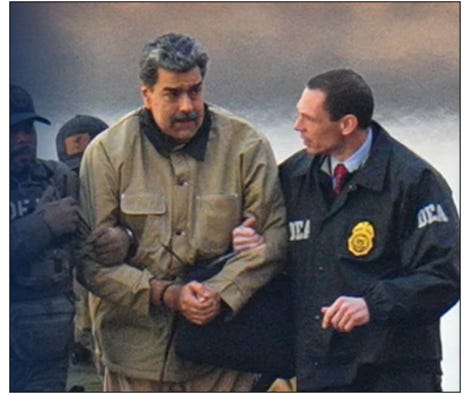
Over the past week, headlines have been dramatic: the U.S. captured Venezuelan strongman Nicolás Maduro and removed him from power. Supporters describe the operation as overdue accountability for a narco-dictator. Opponents, of course, describe it negatively. As usual, the truth — and the context — matters.
This isn’t an argument that military force is cost-free, or that U.S. foreign policy has always been wise. It’s an attempt to provide factual information, why the Trump administration acted as it did, how international law is being interpreted, and why this event is actually precedented, not illegal or a rogue act as some suggest.
First, the facts.
According to U.S. officials, Maduro was taken into custody during a targeted operation and transported to the United States to face long-standing federal charges related to narco-terrorism, cocaine trafficking, and weapons offenses. He has pleaded not guilty, and court proceedings are underway.
The administration has emphasized that this was not a war, not an occupation, and not a regime-change invasion in the traditional sense. It was described as a limited action focused on removing a criminal leader already under U.S. indictment.
Since the Biden administration, the U.S. has recognized Edmundo Gonzalez, the winner of the 2024 elections, as the legitimate head of the government. The United States “does not recognize Nicolás Maduro as the president of Venezuela,” a policy established by then-Secretary of State Anthony Blinken. So, his lack of consent is irrelevant from Washington’s perspective.
That reasoning is important — because it drives the legal and historical logic behind the decision.
Why Venezuela Matters to U.S. National Security
The Trump administration’s justification rests heavily on hemispheric security, not abstract ideology.
For years, Venezuela under Maduro has been described by U.S. officials as a hub for drug trafficking, organized crime, and hostile foreign influence. Successive administrations — Republican and Democrat — have accused the regime of collaborating with cartels and providing safe haven to bad actors linked to Iran, Hezbollah, Russia, and China.
From the current administration’s perspective, this wasn’t just about Venezuela’s internal politics. It was about an unstable, criminalized state in the Western Hemisphere that directly affects U.S. borders, narcotics flows, energy markets, and regional stability.
That doesn’t automatically make every action justified. But it explains why Venezuela has remained on Washington’s radar for so long — and why this administration chose to act rather than continue sanctions and diplomacy alone.
The International Response: Support Is More Nuanced Than Headlines Suggest
Much has been made of the international reaction, often framed as “the world supports the U.S.” or “the world condemns the U.S.” Neither is quite accurate.
Many democratic governments have long refused to recognize Maduro as Venezuela’s legitimate leader. Countries across North and South America, as well as Europe, have recognized the opposition’s electoral claims or rejected Maduro’s legitimacy outright. In that sense, there is broad international agreement that Venezuela’s last election lacked credibility.
At the same time, recognition of the opposition does not always equal endorsement of unilateral military action. While supporting a transition away from Maduro, some U.S. allies expressed concern about the eventual outcome.
By contrast, the strongest condemnations of the operation came from governments that are openly hostile to U.S. interests — including China, Russia, Iran, and regional allies of the Maduro regime. Those reactions were swift and categorical, focusing on sovereignty and aggression.
That distinction matters. Much of the free world wants Maduro gone. Not all agree on how that should happen.
How International Law Is Being Interpreted
International law is rarely as clear-cut as headlines imply, and this case is no exception.
The administration’s legal argument centers on recognition and consent. The U.S. recognizes Venezuela’s opposition leadership — not Maduro — as the legitimate governing authority. Under that framework, actions taken at the request or with the consent of a recognized government are treated differently under international law than actions taken against a legitimate sovereign.
Supporters argue that this places the operation within existing legal doctrine, particularly when combined with Maduro’s status as an indicted criminal accused of transnational narcotics trafficking.
Critics argue and point out that the risks of escalation are real, and that such actions are outside the norm of ‘diplomacy’.
Both arguments exist. What’s often missing from public debate is the acknowledgment that international law in practice is shaped as much by recognition, precedent, and enforcement as by theory.
Is This Unprecedented? Not Really.
One of the loudest claims in recent commentary is that this action bypassed Congress and therefore violated constitutional norms.
History tells a more complicated story.
Presidents of both parties have repeatedly ordered limited military actions without formal congressional declarations of war. From targeted strikes and raids to peacekeeping deployments and counter-terror operations, U.S. forces have been used abroad dozens of times under presidential authority.
That doesn’t mean Congress is irrelevant. It does mean that “war” and “military action” have never been treated as the same thing in modern practice.
Whether one agrees with this reality or not, it’s not new — and it didn’t begin with this administration.
Acknowledging the Objections
It’s important to pause here and acknowledge the strongest objections.
Critics argue that unilateral actions risk unintended consequences, set dangerous precedents, and entangle the U.S. in conflicts that don’t resolve cleanly.
Those concerns deserve to be taken seriously. Skepticism toward foreign intervention is not unpatriotic, nor is it confined to one political party.
But skepticism also cuts both ways.
There are risks and a cost to inaction, prolonged sanctions that entrench regimes, and allowing criminalized states to metastasize near U.S. borders. The debate isn’t between perfection and recklessness. It’s between competing risks.
Why This Moment Is Different
What distinguishes this episode is not the use of force itself, but the target.
Maduro was not a recognized democratic leader. He was a sanctioned, indicted figure accused of running a criminal enterprise while holding power. That fact changes the moral and legal calculus for many observers — even those uncomfortable with the method used.
Whether this action leads to stability, reform, or further turmoil remains to be seen.
Removing Maduro was not a sudden whim, not against precedent, and not a decision made in a vacuum.
A Final Reflection
Foreign policy is rarely clean. It unfolds in a world of imperfect choices, contested law, and competing interests.
Reasonable people can disagree about whether this was the right action. What’s less reasonable is pretending it came out of nowhere, or that it represents some unprecedented descent into lawlessness.
Understanding the logic behind the decision doesn’t require cheering it. It simply requires context — something too often missing in our national conversation.
If we want to debate the wisdom of this moment, we should start by understanding it.
Sources & Further Reading
Primary Reporting: Maduro Capture & Immediate Developments
Reuters – U.S. captures Venezuela President Nicolás Maduro in operation
https://www.reuters.com/world/americas/us-captures-venezuela-president-nicolas-maduro-operation-2026-01-03/
Associated Press – World reacts to U.S. capture of Venezuela’s Maduro
https://apnews.com/article/venezuela-maduro-us-capture-reaction-2026-01-03
PBS NewsHour – What we know about the U.S. capture of Venezuelan leader Nicolás Maduro
https://www.pbs.org/newshour/world/what-we-know-about-the-us-capture-of-venezuelan-leader-nicolas-maduro
International Reactions & Diplomatic Response
Reuters – World reacts to U.S. strikes and capture of Maduro
https://www.reuters.com/world/americas/world-reacts-us-strikes-venezuela-2026-01-03/
Reuters – Venezuela opposition leader Machado meets pope at Vatican
https://www.reuters.com/world/americas/venezuela-opposition-leader-machado-meets-pope-vatican-2026-01-11/
Associated Press – Vatican meeting highlights diplomatic push by Venezuelan opposition
https://apnews.com/article/venezuela-machado-pope-meeting-2026
Trump Administration Rationale & U.S. Perspective
The Daily Signal – Trump celebrates capture of Maduro
https://www.dailysignal.com/2026/01/03/trump-celebrates-capture-maduro-venezuela/
The Federalist – The Venezuela raid was a win for America First anti-interventionism
https://thefederalist.com/2026/01/06/the-venezuela-raid-was-a-win-for-america-first-anti-interventionism/
The Federalist – Outrage from Democrats who once demanded Trump target Maduro is completely fake
https://thefederalist.com/2026/01/05/outrage-from-dems-who-once-demanded-trump-target-maduro-is-completely-fake/
International Law & Recognition Arguments
Fox News – Legal experts say U.S. had international authority to arrest Maduro
https://www.foxnews.com/politics/legal-experts-say-us-had-international-authority-arrest-maduro
Opposition Leadership & U.S. Engagement
Axios – Venezuela opposition leader María Corina Machado to meet Trump
https://www.axios.com/2026/01/07/maria-corina-machado-trump-meeting-venezuela
Court Proceedings
The Epoch Times – Maduro pleads not guilty after U.S. capture; next hearing set
https://www.theepochtimes.com/us/maduro-pleads-not-guilty-after-us-capture-next-hearing-set-5966000
Analysis & Commentary
Doomberg – Silent Allies
Intercessors for America – How the world is reacting to the capture of a dictator
https://ifapray.org/blog/how-the-world-is-reacting-to-the-capture-of-a-dictator/
As always, do your own research and make up your own mind.
White paper on land and water rights: Property Rights and Freedom: A White Paper on America’s Disappearing Land
United we stand. Divided we fall. We must not let America fall.
VoteTexas.gov, https://www.votetexas.gov/get-involved/index.html
Disclaimer:
As always, do your own research and make up your own mind. This Substack is provided for informational and commentary purposes only. All claims or statements are based on publicly available sources and are presented as analysis and opinion, not legal conclusions.
No assertion is made of unlawful conduct by any individual, company, or government entity unless such claims are supported by formal public records or verified legal documents. The views expressed here reflect my personal perspective on property rights and land use issues.
While I strive for accuracy and transparency, readers are encouraged to verify all details using the official sources and references provided. Any references to third-party material are included solely for your consideration and do not necessarily reflect my views or imply endorsement.
If you share this content, please include this disclaimer to preserve context and clarity for all readers.
Until next time…
Please share your thoughts in the comments. Or email me, and let’s have a problem-solving conversation. I welcome ‘letters to the editor’ type emails and may publish yours. I hope we can create a caucus with positive, back-to-the-founders’-dream-for-America results. Have a topic you want to know more about?
Some housekeeping…
Going forward, you may need to check your spam folder. And please mark this address as ‘not spam.’ If the newsletter isn’t in your spam folder either, you should look in the Promotions tab.
You can always see everything on the website, RationalAmerican.org.
Thanks again for reading! I’m glad you’re here!