

Hi friends,
Whether you believe Planned Parenthood was ethical or not, here is the story, beginning to end. The videos are heart-wrenching, listening to them talk coldly about money for baby parts.
In 2015, a little-known activist released a series of undercover videos that would shake one of the most powerful organizations in America—and set off a legal and political battle that still hasn’t fully settled nearly a decade later.
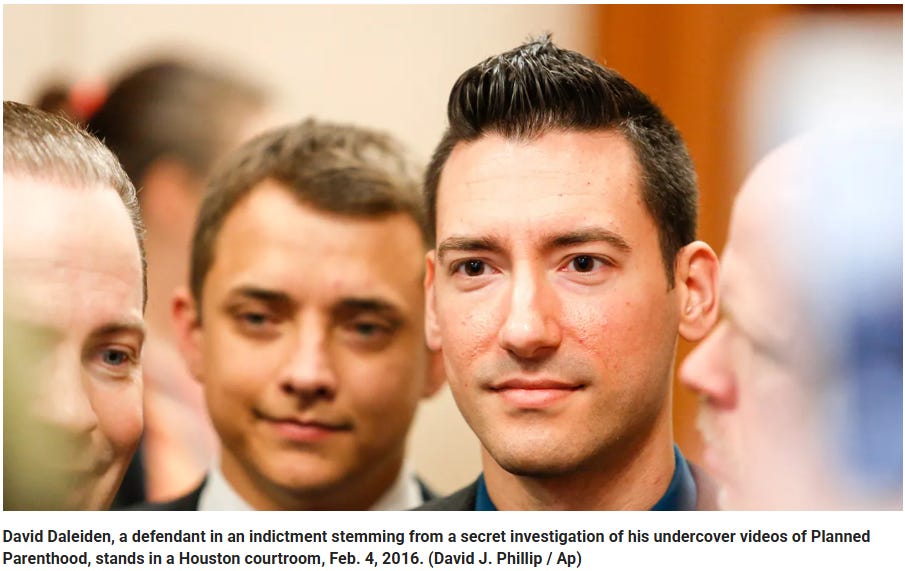
His name was David Daleiden.
At the time, most Americans had never heard of him. But within weeks, his work—recordings of conversations with individuals connected to Planned Parenthood—was everywhere. The videos appeared to show discussions about fetal tissue: how it was obtained, how it was handled, and how it was transferred. To many watching, the language was clinical—but the implications felt anything but.
To supporters, it looked like proof of something deeply troubling: that aborted fetal remains were being treated as commodities. To critics, it looked like a deceptively edited hit job designed to inflame and mislead.
That divide has never really closed.
Daleiden wasn’t a journalist in the traditional sense, but what he did looked a lot like investigative reporting—just with a very clear mission. Through the Center for Medical Progress, he and a colleague spent years building a fake biomedical company, creating false identities, and embedding themselves in conferences and meetings with abortion providers.
Hidden cameras captured hours of conversations. Some of those conversations included references to costs associated with fetal tissue—transport, processing, preservation. In several clips, officials discussed adjusting procedures to preserve certain organs.
That was enough to ignite a national controversy.
The phrase “selling baby parts” quickly took hold in certain circles. Others pushed back hard, arguing that what was being described was legal, tightly regulated, and common in medical research: tissue donation with reimbursement for expenses, not profit.
That distinction—profit vs. reimbursement—became the legal and ethical fault line of the entire debate.
Planned Parenthood’s response was immediate and firm. The organization stated that any fetal tissue donation was voluntary, consent-based, and compliant with federal law. They emphasized that clinics could be reimbursed for actual costs, but not paid for the tissue itself. They also argued that the videos had been selectively edited to create a misleading narrative.
Multiple investigations followed—state (Kamala Harris, Attorney General in CA at the time), federal, congressional. None resulted in criminal charges against Planned Parenthood.
And yet, the controversy didn’t fade.
Because even if something is legal, people still ask whether it is right.
What happened next turned the spotlight away from Planned Parenthood—and directly onto Daleiden himself.
Instead of being treated as a whistleblower, he became the defendant.
Planned Parenthood filed a civil lawsuit accusing him of fraud, illegal recording, trespass, and even racketeering. The case centered not just on what he uncovered, but how he did it. Fake identities. A sham company. Secret recordings in a state—California—that requires all parties to consent.
In 2019, a jury sided with Planned Parenthood. (The case was tried in federal court in San Francisco, with a jury drawn from the local population. While legally a jury of peers, the venue itself—one of the most politically liberal regions in the country—has been noted by critics as a challenging setting for a pro-life defendant.)
The legal outcome may have been very different if the recordings had occurred in a one-party consent state such as Texas—one of roughly 38 states (plus D.C.) where only one participant must consent—rather than in California, which requires consent from all parties.
The judgment against David was staggering: over $2 million in damages, plus more than $13 million in attorney’s fees. Appeals followed, but the core ruling held. The Supreme Court declined to take the case.
On paper, Daleiden now owes more than $15 million.
In reality, it’s unclear how much—if any—has actually been paid. Judgments of that size against individuals often don’t get fully collected. They don’t disappear, but they can sit unresolved for years, sometimes decades, hanging over a person’s financial life indefinitely.
At the same time, a separate criminal case was unfolding in California.
Daleiden and his colleague were charged with multiple felonies related to illegal recording. The case stretched on for years, drawing national attention and accusations of political motivation—especially since it originated under then–Attorney General Kamala Harris.
In 2025, the case finally ended.
The remaining charges were dismissed. The final count was expunged. No jail time. No fines.
In the end, no criminal charges.
From a civil standpoint, the consequences remain.
So what do we make of this?
That depends, in large part, on where you’re standing.
To his supporters, David Daleiden is a whistleblower who exposed a system that many Americans find deeply troubling—and paid the price for it. They see the lawsuits and prosecution as a form of “lawfare,” a way to punish someone for challenging a powerful institution.
To his critics, he’s something else entirely: an activist who broke the law, manipulated footage, and violated privacy in pursuit of a political goal. From that perspective, the legal consequences weren’t persecution—they were accountability.
Both views exist. Both are widely held.
And that’s what makes this story so enduring.
There’s also a deeper issue that continues to linger beneath the surface.
Even after the investigations, even after the court rulings, even after nearly ten years—many Americans still don’t fully understand how fetal tissue practices work, where the legal boundaries are, or how those boundaries are enforced.
They hear phrases like “reimbursement” and “donation,” but also see contracts, logistics, and structured exchanges. For some, that feels like a distinction without a difference. For others, it’s a clear and important line grounded in law and medical ethics.
That gap in understanding keeps the debate alive.
David Daleiden himself remains a figure defined as much by endurance as by controversy.
For nearly a decade, his life has been shaped by courtrooms, legal filings, and public scrutiny. Regardless of how one views his actions, it’s hard to deny the scale of what followed: federal litigation, criminal charges, appeals, and a financial judgment that could shadow him for years to come.
He is still relatively young. That means this story—at least for him—isn’t over.
Not legally. Not financially. And certainly not in the broader cultural conversation.
In the end, the Daleiden case isn’t just about one man or one organization.
It’s about the boundaries of activism.
The limits of undercover tactics.
The role of law in settling moral disputes.
And perhaps most importantly:
Who gets to define the truth—and what it costs to try to expose it.
(This came to my attention from this article, “Final charge dropped in yearslong Harris-era case against pro-life activist”, published on April 3, 2026.)
Sources (for reference and verification):
https://www.centerformedicalprogress.org/
https://www.foxnews.com/politics/final-charge-dropped-yearslong-harris-era-case-against-pro-life-activist
https://www.reuters.com/legal/litigation/abortion-foes-largely-lose-24-mln-appeal-over-planned-parenthood-videos-2022-10-21/
https://www.plannedparenthood.org/about-us/newsroom https://thomasmoresociety.org
https://www.scotusblog.com/cases/case-files/center-for-medical-progress-v-planned-parenthood-federation-of-america/
As always, do your own research and make up your own mind.
White paper on land and water rights: Property Rights and Freedom: A White Paper on America’s Disappearing Land
United we stand. Divided we fall. We must not let America fall.
VoteTexas.gov, https://www.votetexas.gov/get-involved/index.html
Disclaimer:
As always, do your own research and make up your own mind. This Substack is provided for informational and commentary purposes only. All claims or statements are based on publicly available sources and are presented as analysis and opinion, not legal conclusions.
No assertion is made of unlawful conduct by any individual, company, or government entity unless such claims are supported by formal public records or verified legal documents. The views expressed here reflect my personal perspective on property rights and land use issues.
While I strive for accuracy and transparency, readers are encouraged to verify all details using the official sources and references provided. Any references to third-party material are included solely for your consideration and do not necessarily reflect my views or imply endorsement.
If you share this content, please include this disclaimer to preserve context and clarity for all readers.
Until next time…
Please share your thoughts in the comments. Or email me, and let’s have a problem-solving conversation. I welcome ‘letters to the editor’ type emails and may publish yours. I hope we can create a caucus with positive, back-to-the-founders’-dream-for-America results. Have a topic you want to know more about?
Some housekeeping…
Going forward, you may need to check your spam folder. And please mark this address as ‘not spam.’ If the newsletter isn’t in your spam folder either, you should look in the Promotions tab.
You can always see everything on the website, RationalAmerican.org.
Thanks again for reading! I’m glad you’re here!