

Hi friends,
I guess most of us are comfortable by now knowing about and talking about the ‘cloud’. Because information magically appears from thin air when we ask for it, we don’t consciously recognize the ‘hard’ (as in hardware) truths.
AI and data centers are in the news every day. There are basically two sides, and the battle is basically between people/communities and businesses, though governments have a part to play too.
Is the future digital?
Our photos are in the cloud. Our documents are in the cloud. Our banking, shopping, entertainment, and increasingly our artificial intelligence tools all exist in a vast digital world.
The language itself creates a certain image. A cloud sounds light, invisible, doesn’t get in our way.
But the cloud has a physical footprint. A very large one.
Most people think of AI as software, somewhere ‘out there’. In reality, AI depends on an enormous amount of physical land and hardware. The “cloud” is not floating in the sky. It is a growing network of massive buildings filled with computer servers, cooling systems, electrical equipment, backup power systems, water infrastructure, and the land required to support them. Think of a mobile home manufacturing plant, or the home location of Tesla cars.
Not so long ago, data centers were usually discussed as economic-development projects. Communities were told they would bring investment, tax revenue, and jobs. That’s the developers perspective. And maybe government because it always courts large commercial businesses.
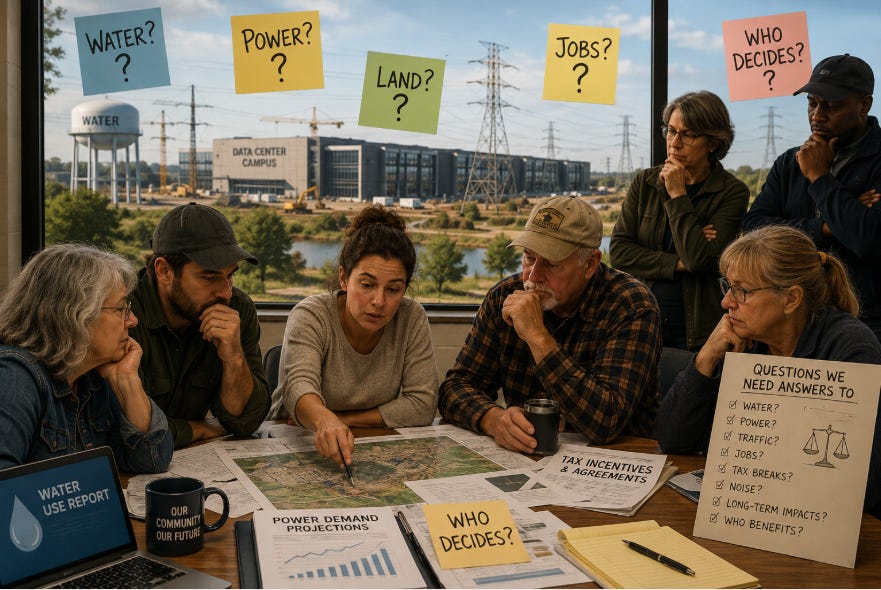
But as projects have grown larger and more numerous, citizens have started asking a different set of questions.
How much water will these facilities use?
Where will that water come from?
How much electricity will they require?
Who pays for new transmission lines and infrastructure?
How many permanent jobs will actually be created?
What happens to farmland, ranchland, and rural communities when industrial-scale development arrives?
And perhaps most importantly:
Who gets to make these decisions?
These questions are no longer coming from a handful of activists or isolated communities.
Across America, local governments are debating moratoriums. Citizens are organizing opposition groups. State officials are raising concerns. National media outlets that once covered data centers as economic-development stories are increasingly covering them as political issues.
The shift is significant. The debate is no longer primarily about AI. The debate is increasingly about the infrastructure being built around AI. That infrastructure extends far beyond a single building.
Data centers require electricity. Electricity requires generation/transmission. Transmission requires land, permits, rights-of-way, and public acceptance.
Many facilities require substantial access to water for cooling systems.
Battery electrical storage systems (BESS) are increasingly being proposed to support reliability and flexibility.
What may seem a simple technology project often turns out to be a much larger infrastructure project.
This is especially true in Texas.
Because of its size, energy resources, available land, and business-friendly environment, Texas has become one of the nation’s primary destinations for data-center development. New projects continue to be proposed across the state.
And Texans are also want answers to the same questions being raised elsewhere in the country. Not whether technology should advance. But whether communities should fully understand the tradeoffs before major decisions are made.
Water has emerged as one of the most common concerns.
In region after region, citizens are asking how much water these facilities require, how usage is measured, and how priorities will be determined between people and industries. Agriculture, residential users, industry, power generation, and data centers all depend on the same finite resource.
Agriculture deserves particular attention.
Unlike many forms of development, productive farmland and ranchland are not replaceable. Water diverted from agricultural production, land removed from farming and ranching, and changes to rural communities can have consequences that last for generations. There must be land and water to grow food and support cattle, pigs, etc.
Electricity is creating a similar concern.
Utilities, grid operators, and planners are discussing extraordinary future demand projections. New generation projects, battery-storage systems, transmission corridors, and industrial power users increasingly appear in the same planning documents. Even when forecasts are uncertain, the infrastructure implications remain substantial.
Some citizens have raised an additional concern that extends beyond land, water, and electricity. What the growing collection of data may ultimately mean for privacy, surveillance, and individual freedom.
The common thread running through all of these issues is a desire for transparency. People need to know what is being built, to understand the costs and benefits, to know how decisions are made.
And they want a meaningful voice in decisions that may reshape their communities for decades. That is citizenship.
Whatever these projects ultimately bring - prosperity, problems, or some combination - NOW is when the questions need answers.
Once the land is converted, the infrastructure is built, the water commitments are made, and the transmission corridors are established, there is no do-over.
We only get one chance to get this right.
For readers who want to explore the specific projects, studies, moratoriums, maps, case studies, and source material behind this article, I’ve included this research supplement (PDF).

As always, do your own research and make up your own mind.
White paper on land and water rights: Property Rights and Freedom: A White Paper on America’s Disappearing Land (8/13/2025)
United we stand. Divided we fall. We must not let America fall.
VoteTexas.gov, https://www.votetexas.gov/get-involved/index.html
Disclaimer:
As always, do your own research and make up your own mind. This Substack is provided for informational and commentary purposes only. All claims or statements are based on publicly available sources and are presented as analysis and opinion, not legal conclusions.
No assertion is made of unlawful conduct by any individual, company, or government entity unless such claims are supported by formal public records or verified legal documents. The views expressed here reflect my personal perspective on property rights and land use issues.
While I strive for accuracy and transparency, readers are encouraged to verify all details using the official sources and references provided. Any references to third-party material are included solely for your consideration and do not necessarily reflect my views or imply endorsement.
If you share this content, please include this disclaimer to preserve context and clarity for all readers.
Until next time…
Please share your thoughts in the comments. Or email me, and let’s have a problem-solving conversation. I welcome ‘letters to the editor’ type emails and may publish yours. I hope we can create a caucus with positive, back-to-the-founders’-dream-for-America results. Have a topic you want to know more about?
Some housekeeping…
Going forward, you may need to check your spam folder. And please mark this address as ‘not spam.’ If the newsletter isn’t in your spam folder either, you should look in the Promotions tab.
You can always see everything on the website, RationalAmerican.org.
Thanks again for reading! I’m glad you’re here!