

Hi friends,
There’s a quiet shift happening that most people haven’t been told about. As the push for artificial intelligence and digital infrastructure accelerates, massive data centers are being built at a rapid pace—and they’re bringing with them a growing demand for land, energy, and water. In some communities, that demand already raising difficult questions.
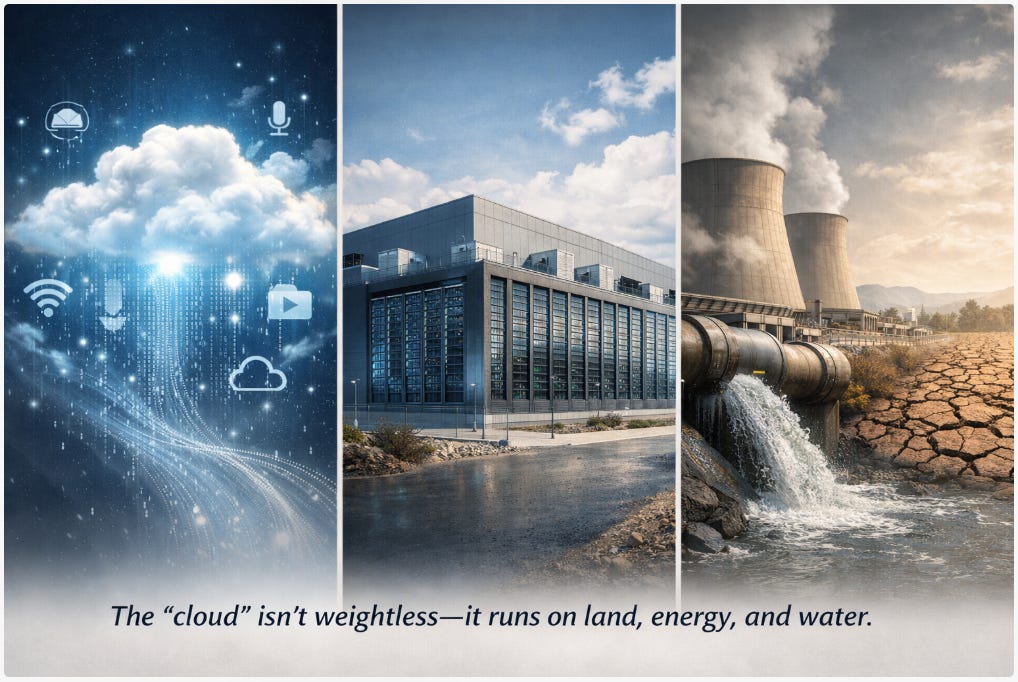
We’re told that the future is digital—that AI is critical to our national economy and security. It sounds clean, efficient, almost weightless. But the reality is much more grounded. The cloud isn’t floating anywhere. It’s built on land, powered by massive infrastructure and, increasingly, drawing from one of our most finite resources: water.
As artificial intelligence expands and data demands grow, data centers are being built at a rapid pace across the country. These aren’t small facilities tucked out of sight. They are large, industrial-scale operations filled with servers that generate enormous amounts of heat and must be cooled continuously. That cooling process, in many cases, requires substantial amounts of water—sometimes hundreds of thousands, even millions of gallons per day.
What’s emerging is a shift in what limits growth. For years, the conversation focused on electricity—how much power these facilities require and how the grid will keep up. But in many areas, especially those already dealing with drought or population growth, water is becoming the more immediate constraint. It’s not just the water used on-site, either. Electricity generation itself often depends on water, which means the true footprint is larger than it appears and is often misrepresented.
That transparency issue must not be ignored. In some communities, details about water usage aren’t fully disclosed, or they’re buried in (non-disclosure) agreements that limit what can be shared publicly. Residents may hear about economic development and new jobs but have a harder time getting clear answers about long-term resource impacts. That gap between what’s promised and what’s understood can make it difficult for communities to fully evaluate what’s coming.
And then there’s the broader pattern—one that may feel familiar. Local residents raise questions. Concerns are voiced about land use, infrastructure strain, or resource allocation. At the same time, projects are often framed in terms of progress, competitiveness, and economic opportunity. Those are not trivial considerations. Data centers do support services people rely on every day. But when those priorities meet local concerns, there is a balancing act—and it doesn’t always land at the local level. And ‘authorities’ can be the point that makes a bad decision for everyone. Citizen engagement is critical.
Another piece that’s easy to miss is how these facilities rarely come alone. A data center doesn’t just occupy land; it tends to bring additional layers with it—expanded power infrastructure, transmission lines, water delivery systems, and backup energy sources. Over time, this creates a kind of stacking effect, where multiple systems converge on the same area, each adding to the overall demand on land and resources.
None of this means data centers are inherently negative. Like most large-scale developments, they come with trade-offs. They support innovation, economic activity, and services that are now deeply embedded in daily life. But they also raise questions that are becoming harder to ignore: how resources are prioritized, how decisions are made, and how much visibility communities have into both.
The digital world isn’t separate from the physical one. It depends on it—on land, on energy, and increasingly, on water. And as that dependency grows, so does the importance of understanding what’s happening behind the scenes.
*See Texas specific piece below the Sources.
Bottom Line
This isn’t a story about one project or even one industry. It’s about a broader shift in how land, water, and infrastructure are being used—and how those decisions are made.
The growth of data centers is part of that shift. And like so many of the issues we’ve been tracking, it comes back to a familiar set of questions: what are the trade-offs, who benefits, and how much say do communities - CITIZENS - have in the process?
As always, understanding what’s happening is the first step toward being able to engage with it in a meaningful way.
Sources:
https://www.washingtonpost.com/opinions/2026/03/25/artificial-intelligence-data-center-water/
https://www.businessinsider.com/how-data-centers-are-deepening-the-water-crisis-2025-6
📍 Texas: Where the Pressure Is Already Building
If this concern isn’t in your area yet, it will be soon.
Texas has quickly become a prime location for data center development. It offers space, a strong energy network, and a regulatory environment that encourages growth. Without proper considerations, it may make sense on paper. But Texas is also a state that already understands what it means to manage competing demands for water.
In places like Lacy Lakeview, near Waco, a proposed data center project has brought that tension into focus. Reports suggest the facility could use an amount of water in a single day that rivals what the city itself uses over a much longer period. Whether those projections hold exactly or evolve over time, the reaction has been telling. Residents aren’t just asking whether the project brings economic benefits—they’re asking what it means for long-term water availability and infrastructure strain.
That concern doesn’t exist in isolation. Across Texas, water is already being pulled in multiple directions—by growing populations, agricultural needs, reservoir expansion plans, and industrial development. Aquifers like the Carrizo–Wilcox are part of that equation, as are regional planning decisions that determine where water is stored, moved, and used.
When a large new demand enters that system, it doesn’t land on a blank slate. It enters a landscape where priorities are already being negotiated, and where every additional use has ripple effects.
There’s also the question of how decisions are made. Texas values local control, but large projects often involve multiple layers of authority—local governments, regional planners, and state-level agencies. That can create situations where residents feel the impact most directly, but don’t always feel they have the final say.
All of this makes Texas something of a preview. It shows what happens when rapid development meets an already complex water environment. It highlights the kinds of questions other regions may soon face: not just whether projects move forward, but how resources are allocated, who decides, and what level of transparency is expected along the way.
As always, do your own research and make up your own mind.
White paper on land and water rights: Property Rights and Freedom: A White Paper on America’s Disappearing Land
United we stand. Divided we fall. We must not let America fall.
VoteTexas.gov, https://www.votetexas.gov/get-involved/index.html
Disclaimer:
As always, do your own research and make up your own mind. This Substack is provided for informational and commentary purposes only. All claims or statements are based on publicly available sources and are presented as analysis and opinion, not legal conclusions.
No assertion is made of unlawful conduct by any individual, company, or government entity unless such claims are supported by formal public records or verified legal documents. The views expressed here reflect my personal perspective on property rights and land use issues.
While I strive for accuracy and transparency, readers are encouraged to verify all details using the official sources and references provided. Any references to third-party material are included solely for your consideration and do not necessarily reflect my views or imply endorsement.
If you share this content, please include this disclaimer to preserve context and clarity for all readers.
Until next time…
Please share your thoughts in the comments. Or email me, and let’s have a problem-solving conversation. I welcome ‘letters to the editor’ type emails and may publish yours. I hope we can create a caucus with positive, back-to-the-founders’-dream-for-America results. Have a topic you want to know more about?
Some housekeeping…
Going forward, you may need to check your spam folder. And please mark this address as ‘not spam.’ If the newsletter isn’t in your spam folder either, you should look in the Promotions tab.
You can always see everything on the website, RationalAmerican.org.
Thanks again for reading! I’m glad you’re here!
Great article, Ellen!