

Hi friends,
The list of questions and concerns has grown. I’m not saying no to data centers. I think that ship has sailed. We do need to be informed and stand up for transparency and control, especially about energy, land and water issues.
The Infrastructure of Artificial Intelligence Is Taking Shape
For the past year or so, much of the discussion surrounding artificial intelligence has focused on the technology itself—chatbots, image generators, automation, and the race for AI leadership.
But a different part of the story is taking the lead.
The real challenge is no longer simply building better AI systems. It is building the physical infrastructure needed to support them.
And that infrastructure story is growing more complex - and concerning - by the week.
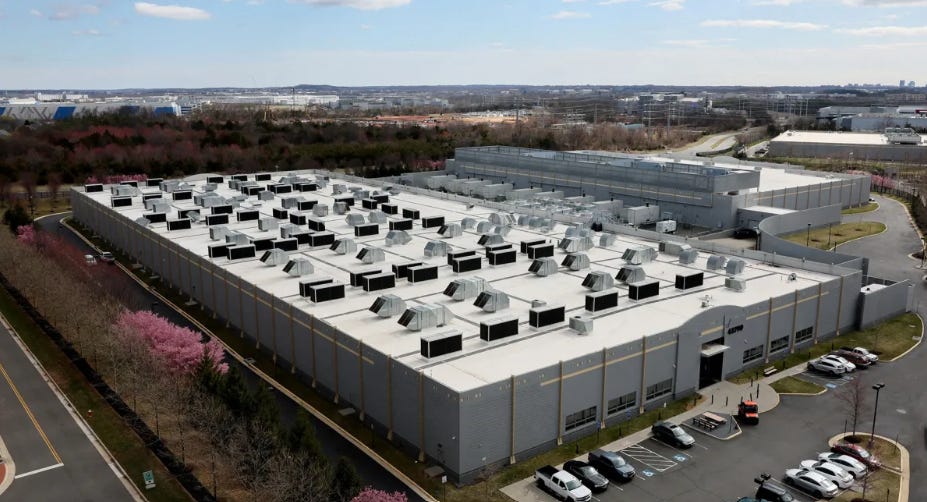
Several developments this week reveal an important shift. AI infrastructure is no longer just a local land-use issue. It involves cities, utilities, regulators, investors, energy companies, and communities across the United States and around the world.
The conversation is moving beyond:
“Should we build data centers?”
to:
“Who decides where they go, how they are powered, how much water they use, and who pays for the infrastructure they require?”
That is a much bigger discussion.
One of the clearest signals comes from a new international effort being launched during London Climate Action Week. Mayors from approximately 40 cities—including London, Melbourne, and Phoenix—are joining a Global Urban Data Centres Pact focused on the impacts data centers can have on electricity systems, water resources, land use, urban planning, noise, and community quality of life.
This development demonstrates that concerns about AI infrastructure are no longer limited to rural counties or isolated citizen groups. Large cities are now organizing around many of the same questions.
Whether the issue is water use in Arizona, electricity demand in Texas, or noise concerns near residential areas, local governments increasingly see data centers as public infrastructure issues rather than simply economic-development projects.
At the same time, investors are moving in a different direction.
According to Reuters, some data-center investors are now purchasing or partnering with power developers in order to gain greater control over electricity supplies. One example is DigitalBridge’s reported $1.1 billion acquisition of ArcLight Capital.
This trend is significant because it suggests that AI companies and their investors are becoming less interested in simply buying electricity from utilities. Instead, they are increasingly looking at owning, financing, or controlling the infrastructure that produces electricity.
In other words, the industry is becoming more vertically integrated.
The implications extend far beyond the data centers themselves.
A power plant serving a data center may require natural-gas supplies, water resources, transmission infrastructure, substations, roads, permits, environmental reviews, batteries, and long-term operating agreements. What starts as a technology project will likely become an energy and infrastructure project too.
A good example is the recently reported Chevron-Microsoft project in Reeves County, Texas.
The proposed 2.67-gigawatt power plant would reportedly serve Microsoft’s AI operations directly and may use brackish water and treated oilfield wastewater rather than potable water supplies.
That approach could potentially reduce pressure on freshwater resources. However, it also raises important questions regarding treatment standards, disposal practices, permitting, future grid connections, land impacts, and local oversight.
The lesson is not that the project is necessarily good or bad.
The lesson is that infrastructure decisions are becoming more complicated.
Meanwhile, the most important decisions may be occurring in places that receive very little public attention.
In Texas, ERCOT’s upcoming “Batch Zero” process will help determine how large new electricity users connect to the grid. Utility Dive recently reported that Texas is facing approximately 438 gigawatts of large-load requests, nearly 90 percent of which are associated with data centers.
Most of those projects will never be built. But the numbers illustrate the scale of interest. The key questions are no longer simply whether Texas can generate enough electricity.
Increasingly, the questions are:
Who receives access to limited grid capacity?
Who pays for upgrades?
How are costs allocated?
How should reliability be protected?
Those are utility-law questions.
And utility law is becoming one of the most important battlegrounds in the AI infrastructure debate.
The same pattern is now appearing nationally.
On June 18, the Federal Energy Regulatory Commission (FERC) directed regional grid operators outside Texas to update or justify their approaches to handling large-load interconnection requests.
Again, the central question is not technology. The central question is governance. Who gets electricity first? Who pays for upgrades? Who bears the risk?
Water remains part of the story as well.
The new city coalition is focusing heavily on water use and drought resilience. At the same time, projects such as the Great Springs initiative between San Antonio and Austin highlight a growing realization that protecting water resources increasingly involves protecting land, aquifer recharge areas, and long-term infrastructure planning.
Takeaways from this week’s developments:
AI infrastructure is becoming vertically integrated.
Data-center investors are moving into power generation.
Cities are organizing around infrastructure impacts.
Grid operators are developing new rules.
Regulators are stepping in.
Bottom Line: AI infrastructure is becoming vertically integrated, data-center money is moving into power generation, cities and regulators are trying to catch up.
Sources:
Global Urban Data Centres Pact (Cities Organizing Around Data-Center Impacts)
Reuters (June 22, 2026)
City mayors from London to Melbourne seek to curb data centre burden on power, water
https://www.reuters.com/sustainability/cop/city-mayors-london-melbourne-seek-curb-data-centre-burden-power-water-2026-06-22/
C40 Cities – Global Urban Data Centres Pact
https://www.c40.org/news/the-global-urban-data-centres-pact/
Associated Press (June 22, 2026)
40 mayors worldwide endorse a pact to shape data center development
https://apnews.com/article/37df5184ad4f28ea084082563182e1ea
Data-Center Investors Moving Into Power Generation
Reuters (June 22, 2026)
Data center investors buy up power developers in race to build
https://www.reuters.com/business/energy/data-center-investors-buy-up-power-developers-race-build--reeii-2026-06-22/
DigitalBridge / ArcLight Announcement (May 27, 2026)
DigitalBridge and ArcLight Announce Strategic Combination
https://www.digitalbridge.com/news/2026-05-27-digitalbridge-and-arclight-announce-strategic-combination-to-form-a-leading-alternative-asset-manager-at-the-convergence-of-power-ai-and-digital-infrastructure
Chevron / Microsoft / West Texas AI Power Project
Houston Chronicle (June 23, 2026)
Chevron plans massive Texas power plant for Microsoft, eyes oilfield wastewater as water source
https://www.houstonchronicle.com/business/article/chevron-microsoft-permian-gas-produced-water-22315265.php
Midland Reporter-Telegram (June 23, 2026)
Chevron, Microsoft sign 20-year deal for Pecos data center
https://www.mrt.com/news/article/pecos-tx-chevron-microsoft-data-center-22315597.php
ERCOT Large Loads / Batch Zero
ERCOT Large Load Update (April 1, 2026)
https://www.ercot.com/files/docs/2026/04/01/ERCOT_LargeLoad_Update_April2026_B-C_-Hearing.pdf
National Grid Rules / FERC
FERC Large-Load Interconnection Actions (June 2026)
Water Planning / Great Springs
As always, do your own research and make up your own mind.
White paper on land and water rights: Property Rights and Freedom: A White Paper on America’s Disappearing Land (8/13/2025)
United we stand. Divided we fall. We must not let America fall.
VoteTexas.gov, https://www.votetexas.gov/get-involved/index.html
Disclaimer:
As always, do your own research and make up your own mind. This Substack is provided for informational and commentary purposes only. All claims or statements are based on publicly available sources and are presented as analysis and opinion, not legal conclusions.
No assertion is made of unlawful conduct by any individual, company, or government entity unless such claims are supported by formal public records or verified legal documents. The views expressed here reflect my personal perspective on property rights and land use issues.
While I strive for accuracy and transparency, readers are encouraged to verify all details using the official sources and references provided. Any references to third-party material are included solely for your consideration and do not necessarily reflect my views or imply endorsement.
If you share this content, please include this disclaimer to preserve context and clarity for all readers.
Until next time…
Please share your thoughts in the comments. Or email me, and let’s have a problem-solving conversation. I welcome ‘letters to the editor’ type emails and may publish yours. I hope we can create a caucus with positive, back-to-the-founders’-dream-for-America results. Have a topic you want to know more about?
Some housekeeping…
Going forward, you may need to check your spam folder. And please mark this address as ‘not spam.’ If the newsletter isn’t in your spam folder either, you should look in the Promotions tab.
You can always see everything on the website, RationalAmerican.org.
Thanks again for reading! I’m glad you’re here!