

Hi friends,
When we’re not happy with the way government is going - local, state, or federal, complaining is not the way to improve it.
Vote! The coming midterm election is super important.
Make your voice heard.
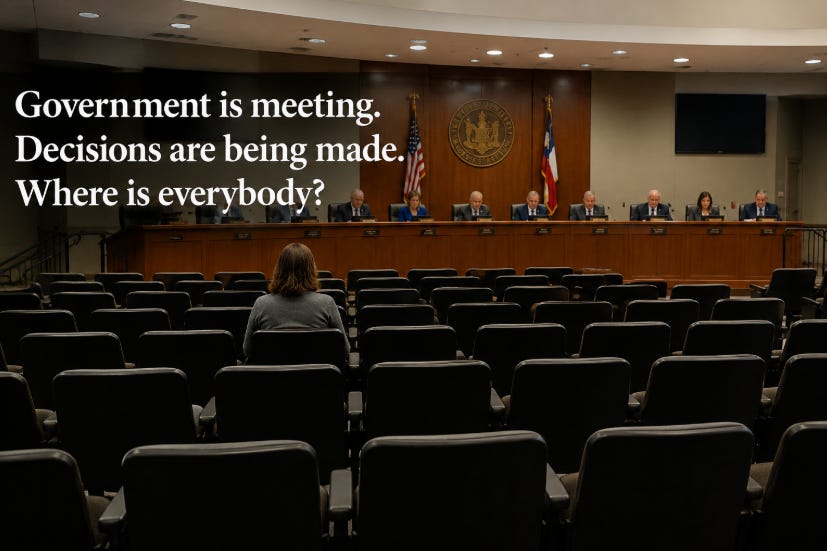
America has more information than ever. The problem is that too few citizens are watching, participating, or even voting.
America has never had more information available to ordinary citizens.
We can watch city council meetings from home, download county agendas, search legislation, read budgets, email elected officials, find polling places, look up campaign finance reports, and publish what we discover to thousands of people—all from a phone or laptop.
And yet there is a troubling paradox:
It has never been easier for ordinary Americans to find information about their government. And perhaps never easier to ignore it.
That matters because self-government depends on citizens doing something remarkably basic: paying attention and participating.
Not everyone needs to become an activist. Not everyone has time to attend government meetings, study every issue, or monitor public records.
But enough people have to care. Enough have to watch.
And, at the very least, enough have to vote.
The turnout numbers should bother us
Americans usually do much better in presidential elections. Census data show about 65% of eligible citizens voted in 2024.
Move down the ballot, however, and participation can collapse.
Texas turnout for the 2023 constitutional-amendment election was only about 14% of registered voters. Collin County Texas turnout in its May 2025 local election was about 11%.
That means a relatively tiny portion of the electorate can determine who runs local government, how tax dollars are spent, whether bonds are approved, and who sits on school boards and city councils.
There are understandable reasons people disengage.
They are busy. Politics is unpleasant. Some distrust government and the media. Some believe their vote will not matter. Some don’t know enough about the candidates. Others simply don’t realize an election is occurring.
Those explanations deserve understanding.
But they don’t change the arithmetic of self-government.
If most people don’t participate, the people who do participate make the decisions.
Freedom still asks something of us.
Something else has disappeared: the people who used to watch
At the same time citizens have become less engaged, America’s local information system has been shrinking.
Nearly 40% of American local newspapers have disappeared since 2005. Roughly 50 million Americans now live in communities with limited or no reliable local news coverage.
And the decline is deeper than newspaper closures alone. A 2026 Local Journalist Index estimated that America has lost roughly four-fifths of its local reporting capacity since the early 2000s.
That doesn’t mean every old newspaper was wonderful. It certainly doesn’t mean reporters always asked the right questions.
But someone used to have an assigned job that sounded roughly like this:
Watch city hall. Watch the county. Attend the meeting. Read the proposal. Ask questions. Tell people what happened.
Today, in many communities, nobody has that assignment.
Government may technically be transparent, or appear so. The agenda is online. The contract is posted. The hearing notice exists.
But transparency isn’t the same thing as awareness.
A 400-page agenda packet sitting unnoticed on a government website does very little for citizens who don’t know there is something inside it worth reading.
The grapevine is replacing some of the newsroom
People have not stopped exchanging local information.
Quite the opposite.
Friends, family and neighbors are now among Americans’ most common sources of local political information. Facebook groups, Nextdoor, community newsletters, government social-media pages, independent websites and citizen journalists increasingly fill gaps left by traditional local media.
That can be a good thing.
A citizen journalist can attend a school-board meeting. A retired engineer can understand a utility proposal better than a general-assignment reporter. A neighborhood resident may know a zoning case intimately. A local Substack can publish documents without waiting for an editor to decide whether the story is important.
But there is a major difference between information spreading and somebody systematically watching.
The grapevine is excellent at:
“Did you hear what happened?”
It is much less reliable at:
“Did you notice Item 14 on next Tuesday’s county agenda?”
By the time everybody is asking, “How did this happen?”, the vote may already be over.
That has consequences beyond bad government
This is where the problem gets bigger.
Research has linked the loss of local journalism with higher government borrowing costs, reduced political knowledge, lower turnout, more straight-party voting and increased political polarization.
A 2026 study also found relationships between news deserts and weakened social capital—the trust, networks and civic participation that help communities function.
That doesn’t mean disappearing newspapers caused America’s polarization.
They didn’t.
But the erosion of local civic information appears to be one ingredient in a much larger weakening of community life.
And the reason makes sense.
National politics constantly reminds us what divides us.
Local life constantly reminds us what we share.
Your Republican neighbor and Democratic neighbor may disagree passionately about Washington and still agree that the road needs fixing, the water supply needs protecting, property taxes matter, children deserve good schools, and the neighborhood should be safe.
Working together on those things builds relationships.
It creates community.
And perhaps more importantly, it gives people practice at self-government.
The deeper problem: we may be losing the habit of citizenship
Alexis de Tocqueville noticed something unusual about Americans almost two centuries ago.
When Americans encountered a problem, they tended to form associations and do something about it. Civic groups, churches, clubs, committees, charities and local organizations created what he called the “science of association.”
People learned democracy by practicing it together.
Decades later, Robert Putnam described something similar as “social capital”—networks of trust, cooperation and reciprocity.
Those networks do more than create friendships. They create information.
Someone says: “Did you know there’s an election Saturday?” “Have you seen what the city is considering?” “Can you come to the meeting?” “Will you help?”
That is simultaneously a social network and a civic-information network.
Americans still help their neighbors. Volunteerism has actually rebounded somewhat since the pandemic.
But other indicators have weakened over decades: fewer people know most of their neighbors, interpersonal trust has declined, people spend more time alone, many civic organizations are smaller, and relatively few Americans participate deeply in civic life.
A 2026 Pew study divided Americans into four engagement groups.
Only 9% were highly active “Mobilizers.”
Another large group consisted essentially of spectators—people who follow news and politics but rarely translate that attention into civic action.
That distinction may be one of the most important of all:
Following politics is not the same thing as practicing citizenship.
You can watch political television for three hours a night, read twenty posts, argue online and still never vote in the school-board election.
Participation itself appears to become a habit
Here is the hopeful part.
Research suggests voting can be habit-forming.
Participating in one election makes participation in future elections more likely. Personal neighbor-to-neighbor contact can increase turnout. Civic participation tends to cluster with volunteering, association membership and other forms of community engagement.
In other words:
Participation can reinforce participation.
So can disengagement.
That means one additional voter isn’t necessarily just one additional ballot.
It could be the beginning of another habitual voter.
One person who attends a meeting may attend another.
Someone who learns about one local issue may begin watching another.
Someone who sends useful information to ten neighbors may become the person those neighbors rely upon.
Citizenship can spread through relationships.
We don’t need everybody
This is important because telling everybody to “get involved” is unrealistic.
People have lives.
Some will never attend a public meeting. Some will never monitor government documents. Some want nothing to do with politics.
Fine.
Self-government doesn’t require every citizen to become an activist.
It requires enough citizens to act like citizens.
Maybe the challenge is simply to move one notch upward.
Don’t vote? Vote.
Only vote for president? Vote locally.
Already vote? Learn about one local issue.
Already reading? Tell somebody else.
Already informed? Attend one meeting.
Already active? Watch one part of government consistently.
The goal isn’t perfection.
It’s participation.
What if one more person did something?
One more voter.
One more neighbor paying attention.
One more person willing to ask a question.
One more person willing to read the document before repeating the rumor.
One more person willing to tell ten others what is happening.
One more person who decides:
“This one is my responsibility.”
America’s constitutional system is remarkable.
But no constitution can operate itself.
Self-government depends on habits, expectations and citizens willing to do their part.
Americans need to recover the habit of citizenship.
Not because everyone must become political.
Because self-government has never been a spectator sport.
And maybe rebuilding it begins with a much smaller question:
What if one more person did something?
As always, do your own research and make up your own mind.
White paper on land and water rights: Property Rights and Freedom: A White Paper on America’s Disappearing Land (8/13/2025)
United we stand. Divided we fall. We must not let America fall.
VoteTexas.gov, https://www.votetexas.gov/get-involved/index.html
Disclaimer:
As always, do your own research and make up your own mind. This Substack is provided for informational and commentary purposes only. All claims or statements are based on publicly available sources and are presented as analysis and opinion, not legal conclusions.
No assertion is made of unlawful conduct by any individual, company, or government entity unless such claims are supported by formal public records or verified legal documents. The views expressed here reflect my personal perspective on property rights and land use issues.
While I strive for accuracy and transparency, readers are encouraged to verify all details using the official sources and references provided. Any references to third-party material are included solely for your consideration and do not necessarily reflect my views or imply endorsement.
If you share this content, please include this disclaimer to preserve context and clarity for all readers.
Until next time…
Please share your thoughts in the comments. Or email me, and let’s have a problem-solving conversation. I welcome ‘letters to the editor’ type emails and may publish yours. I hope we can create a caucus with positive, back-to-the-founders’-dream-for-America results. Have a topic you want to know more about?
Some housekeeping…
Going forward, you may need to check your spam folder. And please mark this address as ‘not spam.’ If the newsletter isn’t in your spam folder either, you should look in the Promotions tab.
You can always see everything on the website, RationalAmerican.org.
Thanks again for reading! I’m glad you’re here!
Well done thank you