

Hi friends,
I bet you’ve been hearing/reading about property rights and landowner woes all across America.
There’s a plethora of concerns: Solar, wind, AI, data centers, nuclear and nuclear waste facilities, Battery Energy Storage Systems (BESS), hithium, lithium, hydrogen, reservoirs, biosolids, CO2 capture, ethanol, eminent domain, ‘conservation’, 765 kv transmission lines, expanding government land ownership with no people/no roads requirements, even oil, minerals, and cloud seeding.
All adversely affect energy, food, water, land, and air. Sure, some have good points. I’m not advocating for stopping progress. BUT, it’s critical to fight for the good to outweigh the bad.
Farms, ranches, timber/forests, wetlands, wildlife, endangered species, even schools and cemeteries are falling to ‘progress’, especially technology.
Take a deeper look at any one of them, and you’ll learn the concerns. People are less and less considered, or even allowed to speak, while governments/agencies and Big Business tout the great benefits without addressing known, much less unknown, ‘side effects’.
(See more at propertyrightsandfreedom.substack.com/archive)
Here’s the latest project I’ve learned about.
Project Matador is a real proposed advanced energy and data campus in Carson County near Amarillo, backed by official NRC nuclear-license filings and TCEQ air-permit actions. It is being marketed by Fermi America as an extremely large private power-and-data project, but its ultimate scale and full buildout remain proposed . It is drawing attention as a large-scale energy and data infrastructure development planned for Carson County, Texas, near Amarillo. Public records confirm that the project is not speculative—there are active filings with the Nuclear Regulatory Commission for a four-unit nuclear facility, referred to in those documents as the “Donald J. Trump Generating Plant – Units 1–4.” (You can find the 247-page document here.) At the same time, the project has moved through the Texas permitting process, with the Texas Commission on Environmental Quality reviewing and issuing permits for a substantial on-site natural gas power plant intended to support a hyperscale data center campus.
What makes Project Matador notable is its structure: rather than relying on existing grid power, the proposal combines multiple forms of energy generation—natural gas, and potentially nuclear in later phases—directly with a large data center operation. According to permitting materials, the power produced would be used on-site rather than distributed through the broader grid. This reflects a growing trend in which energy-intensive industries, particularly AI and data centers, are beginning to develop dedicated, self-contained power systems to meet rising demand.
While the project has been described in promotional materials as potentially one of the largest of its kind, its full scope and final buildout remain in the proposal and permitting stages. The nuclear component is still undergoing federal review, and long-term timelines and capacity are not yet finalized. Even so, Project Matador offers a clear example of how land use, energy infrastructure, and large-scale industrial development are increasingly being planned together—raising important questions about local governance, resource allocation, and the long-term impacts on surrounding communities.
Many large industrial facilities now promote “closed-loop” water systems as a solution to water consumption concerns. While these systems do reduce withdrawals compared to once-through designs, they are not truly closed. Water is continuously lost through evaporation and must be replaced, and contaminants become concentrated over time, requiring chemical treatment and periodic discharge. In practice, closed-loop systems shift how water is used and managed rather than eliminating demand—raising important questions about long-term sustainability and local resource allocation.
Read more about “closed-loop” water systems here (orf.od.nih.gov) and here.
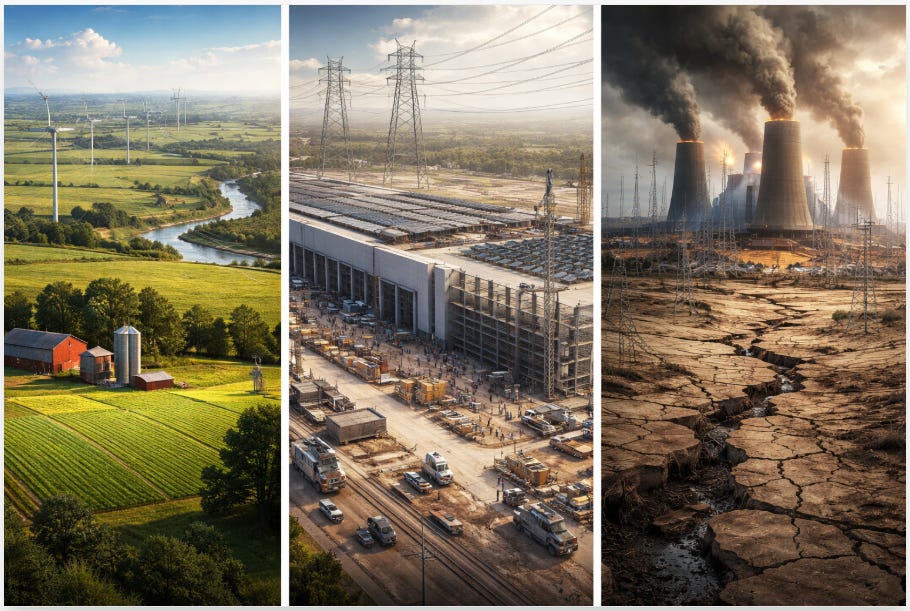
Project Matador is more than just another proposed development—it is a clear signal of where infrastructure planning is heading. Energy production, data processing, and industrial land use are no longer being treated as separate systems, but as integrated, large-scale complexes with long-term implications for surrounding communities. A data center, for example, doesn’t just occupy land; it tends to bring additional layers with it—expanded power infrastructure, transmission lines, water delivery systems, and backup energy sources. Over time, this creates a kind of stacking effect, where multiple systems converge on the same area, each adding to the overall demand on land and resources. While this project remains in the proposal and permitting stages, its structure alone raises important questions about how resources are allocated, who benefits, and how local impacts are weighed against national or corporate priorities. Project Matador also reflects a broader shift toward integrated systems that concentrate power, water, and land use in ways communities have not historically had to navigate. And as these layers continue to stack—energy, water, infrastructure, and industrial use—the long-term implications become more problematic. As projects like this move forward, transparency, oversight, and informed public engagement will be essential to ensure that decisions made today do not create unintended consequences for decades to come.
Here’s a great quote from Margaret Byfield of American Stewards of Liberty:
”America was founded on this core principle: that the people would have the right to own and fully utilize the land. But as the West was settled, instead of disposing of the lands, the federal government became the landowner.
“Importantly, however, Congress also guaranteed that our multiple-use lands—and even protected lands—would not be locked up from the people. These lands would be productively used, except in very rare cases as Congress determined, to ensure every citizen had the opportunity to help steward the land, witness its infinite beauty and wildlife, and enjoy the bountiful resources it produces for human flourishing.”
From docs.house.gov/meetings/II/II10/20260210/118899/HHRG-119-II10-Wstate-ByfieldM-20260210.pdf
Sources:
Cooling tower mechanics, evaporation, blowdown, and makeup water:
https://en.wikipedia.org/wiki/Cooling_towerGeneral water cooling systems, including recirculation and chemical concerns:
https://en.wikipedia.org/wiki/Water_coolingAI/data center water use, including evaporation losses and closed-loop context:
https://en.wikipedia.org/wiki/The_water_consumption_of_AI_data_centers
EPA case study (Quincy, WA) – water reuse reducing groundwater demand:
https://www.epa.gov/waterreuse/water-reuse-case-study-quincy-washingtonClosed-loop cooling reducing freshwater use (industry example up to ~70%):
https://www.fwpcoa.org/content.aspx?club_id=859275&item_id=130961&page_id=5
Chemical risks and environmental concerns in closed-loop systems:
https://ketos.co/closed-loop-cooling-water-saver-or-chemical-time-bombBlowdown losses and hidden inefficiencies in data center cooling systems:
https://genesiswatertech.com/blog-post/the-data-center-water-efficiency-paradox-why-your-cooling-tower-is-wasting-more-water-than-you-think/DOE guidance on blowdown and cycles of concentration (ongoing water loss reality):
https://www.energy.gov/femp/cooling-water-efficiency-opportunities-federal-data-centers
Closed-loop (air-cooled) systems may reduce water use but be less energy efficient:
https://journal.uptimeinstitute.com/dont-ignore-water-consumption/
Data center water demand and blowdown reuse challenges:
https://ide-tech.com/en/blog/data-centers-water-turning-cooling-tower-blowdown-into-a-strategic-resource/Overview of closed-loop / close-coupled cooling approaches in data centers:
https://www.datacenterknowledge.com/cooling/what-is-closed-loop-cooling-and-when-should-data-centers-use-it-DOE – Cooling Water Efficiency
https://www.energy.gov/femp/cooling-water-efficiency-opportunities-federal-data-centersKETOS – Closed Loop Cooling Risks
https://ketos.co/closed-loop-cooling-water-saver-or-chemical-time-bombGenesis Water Tech – Blowdown & Water Efficiency
https://genesiswatertech.com/blog-post/the-data-center-water-efficiency-paradox-why-your-cooling-tower-is-wasting-more-water-than-you-think/IDE Technologies – Data Center Water Use
https://ide-tech.com/en/blog/data-centers-water-turning-cooling-tower-blowdown-into-a-strategic-resource/Data Center Knowledge – Cooling Systems Overview
https://www.datacenterknowledge.com/cooling/what-is-closed-loop-cooling-and-when-should-data-centers-use-it-
As always, do your own research and make up your own mind.
White paper on land and water rights: Property Rights and Freedom: A White Paper on America’s Disappearing Land
United we stand. Divided we fall. We must not let America fall.
VoteTexas.gov, https://www.votetexas.gov/get-involved/index.html
Disclaimer:
As always, do your own research and make up your own mind. This Substack is provided for informational and commentary purposes only. All claims or statements are based on publicly available sources and are presented as analysis and opinion, not legal conclusions.
No assertion is made of unlawful conduct by any individual, company, or government entity unless such claims are supported by formal public records or verified legal documents. The views expressed here reflect my personal perspective on property rights and land use issues.
While I strive for accuracy and transparency, readers are encouraged to verify all details using the official sources and references provided. Any references to third-party material are included solely for your consideration and do not necessarily reflect my views or imply endorsement.
If you share this content, please include this disclaimer to preserve context and clarity for all readers.
Until next time…
Please share your thoughts in the comments. Or email me, and let’s have a problem-solving conversation. I welcome ‘letters to the editor’ type emails and may publish yours. I hope we can create a caucus with positive, back-to-the-founders’-dream-for-America results. Have a topic you want to know more about?
Some housekeeping…
Going forward, you may need to check your spam folder. And please mark this address as ‘not spam.’ If the newsletter isn’t in your spam folder either, you should look in the Promotions tab.
You can always see everything on the website, RationalAmerican.org.
Thanks again for reading! I’m glad you’re here!