

Hi friends,
I saw this Texas Scorecard article today and I did some digging on the status of ‘new parks’ the voters approved in 2023.
Addie Hovland reports that the recently acquired Silver Lake Ranch in the Hill Country is set to become a new state park.
Located between Uvalde and Rocksprings, the Silver Lake Ranch encompasses almost 54,000 acres. When it opens, it will be the second-largest state park in Texas.
The Palo Pinto Mountains State Park—the first new state park in 25 years—just opened in March.
https://texasscorecard.com/state/new-state-park-coming-to-the-texas-hill-country/
More Parks May Sound Nice — Until You Count the Acres and the Tax Dollars
In 2023, Texas voters approved Proposition 14, a constitutional amendment creating the Centennial Parks Conservation Fund.
The ballot pitch was easy to love: more state parks. Who is against parks?
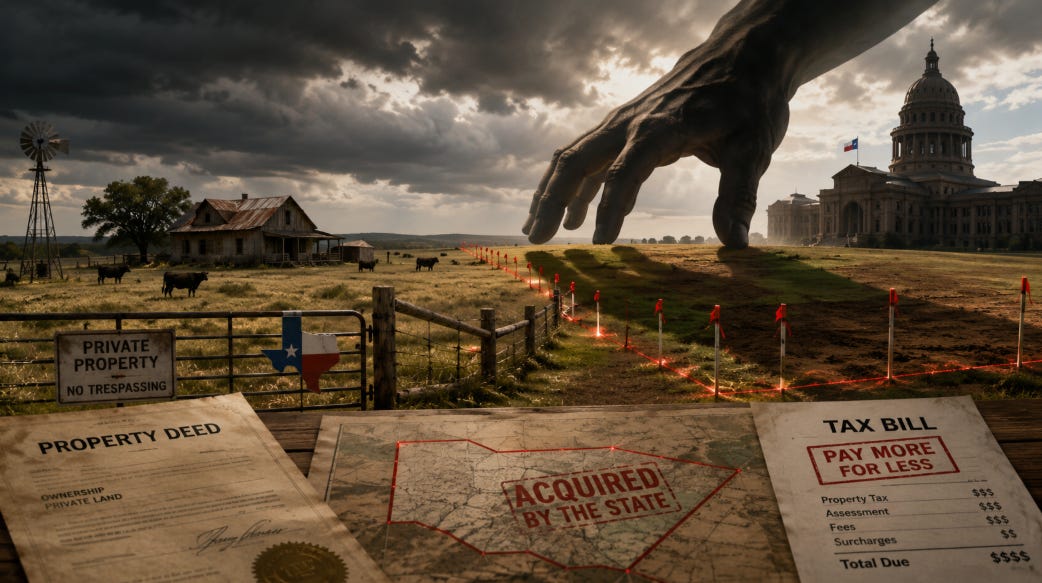
But what too many voters didn’t see what that vote actually created: a $1 billion fund for purchasing land and developing new Texas state parks. That means more land moved into state government ownership and control, more long-term obligations, and more tax expenses that do not end when the ribbon is cut, are ongoing in perpetuity.
The newest example is Silver Lake State Park.
Texas Parks and Wildlife recently announced that the nearly 54,000-acre Silver Lake Ranch, located in Edwards and Kinney counties between Uvalde and Rocksprings, will become Texas’ second-largest state park. The state purchased the undonated portion for $11.85 million, using the Centennial Parks Conservation Fund and sporting-goods-sales-tax revenue. Both the Fund and the sales tax come directly from YOUR pocket.
Once any land becomes government owned, including state parks, taxpayers are on the hook for the long-term obligations. Roads, gates, trails, parking, restrooms, water access, staffing, law enforcement, wildfire response, rescue operations, resource studies, visitor facilities, repairs, and ongoing maintenance all cost money. And we know how government spends taxpayer money - not very efficiently.
None of this stops costing money. Ever. Period.
And the $1 billion fund is not the whole cost. By law, the Centennial Parks money is restricted; it cannot be used for TPWD salaries, benefits, administration, routine operations, or park maintenance. So even after land is acquired and developed, Texans still have to pay for staffing, repairs, roads, emergency response, utilities, and long-term upkeep.
There is another cost voters rarely hear about: land moved into state ownership generally comes off the local property-tax rolls. Private ranch land, even with agricultural exemptions, still supports counties, schools, roads, emergency services, and local government. State-owned parkland - not so much.
Sometimes tourism helps. A new park can bring visitors, hotel stays, restaurants, gas purchases, and outdoor recreation dollars. That is the positive side, but it benefits specific persons while ALL taxpayers support the expense side.
And it is not the same thing as private land staying productive, taxable, and locally controlled. Nor does tourism erase the long-term cost of turning tens of thousands of acres into government-owned and controlled land.
And Silver Lake is just the latest case.
Palo Pinto Mountains State Park, more than 4,800 acres between Abilene and Dallas-Fort Worth, opened to visitors in 2026 after years of development. Under the new Centennial Parks program, Texas has also acquired Bear Creek State Park in 2025, where planning is underway for public access as staff members are hired. Texas has also acquired land (2025) for Post Oak Ridge State Park near Lampasas, including two ranch properties costing $47.1 million, and added 3,702 acres to Enchanted Rock State Natural Area.
In other words, the machinery is already moving.
But the broader concern still matters too.
Texas is growing rapidly. Land is becoming more expensive. Housing is harder to find, much less afford. Rural communities are under pressure from reservoirs, transmission corridors, data centers, battery storage projects, conservation programs, and other land-intensive plans.
Every acre matters - cost taxpayers money, don’t produce food, use water for other than actual people, limits access (100% of parks’ acreage are not accessible to the public).
So. While more parks may sound nice, and it’s too late to undo this Constitutional amendment, we still have to pay attention and try to control what we can.
Where does it stop? Or does it stop at all?
Government programs almost never shrink themselves. Once a fund exists, the momentum usually moves in one direction — more land, more projects, more spending, more staffing, more maintenance, and more justification for the next request.
Today it is Silver Lake. Tomorrow it may be another ranch, another conservation corridor, another “once-in-a-generation opportunity,” another “critical habitat,” another “public access” project, another billion-dollar request.
And each time, voters will be ‘fooled’ by the shortcut ‘explanation’ of ‘more parks’ (or whatever) but not told the whole story.
How much private land can we afford to have the government own and control?
To make the point, we keep losing land, but owing increased taxes for the land we lost. Where will that lead us? Serfdom?
And who gets to say, “Enough”? If we, the residents/voters/citizens, do not stand up and speak out, it won’t stop. It won’t even slow down…
Sources:
Texas Parks and Wildlife — Silver Lake State Park announcement:
https://tpwd.texas.gov/newsmedia/releases/?req=20260527a
Texas Parks and Wildlife — Centennial Parks Conservation Fund:
https://tpwd.texas.gov/state-parks/park-information/parks-fund
Texas Parks and Wildlife — Palo Pinto Mountains State Park opening:
https://tpwd.texas.gov/newsmedia/releases/?req=20260225b
Texas Constitution / SJR 74 ballot language:
https://capitol.texas.gov/tlodocs/88R/billtext/pdf/SJ00074F.pdf
Texas Legislature — SB 1648 Bill Analysis / Centennial Parks Conservation Fund:
https://capitol.texas.gov/tlodocs/88R/analysis/html/SB01648F.htm
Texas Tribune background on the $1 billion park fund and new park acquisitions:
https://www.texastribune.org/2025/07/28/new-texas-state-parks-centennial-land-funding/
As always, do your own research and make up your own mind.
White paper on land and water rights: Property Rights and Freedom: A White Paper on America’s Disappearing Land
United we stand. Divided we fall. We must not let America fall.
VoteTexas.gov, https://www.votetexas.gov/get-involved/index.html
Disclaimer:
As always, do your own research and make up your own mind. This Substack is provided for informational and commentary purposes only. All claims or statements are based on publicly available sources and are presented as analysis and opinion, not legal conclusions.
No assertion is made of unlawful conduct by any individual, company, or government entity unless such claims are supported by formal public records or verified legal documents. The views expressed here reflect my personal perspective on property rights and land use issues.
While I strive for accuracy and transparency, readers are encouraged to verify all details using the official sources and references provided. Any references to third-party material are included solely for your consideration and do not necessarily reflect my views or imply endorsement.
If you share this content, please include this disclaimer to preserve context and clarity for all readers.
Until next time…
Please share your thoughts in the comments. Or email me, and let’s have a problem-solving conversation. I welcome ‘letters to the editor’ type emails and may publish yours. I hope we can create a caucus with positive, back-to-the-founders’-dream-for-America results. Have a topic you want to know more about?
Some housekeeping…
Going forward, you may need to check your spam folder. And please mark this address as ‘not spam.’ If the newsletter isn’t in your spam folder either, you should look in the Promotions tab.
You can always see everything on the website, RationalAmerican.org.
Thanks again for reading! I’m glad you’re here!
The powers that be are at it in spades.
Thank you