

Hi friends,
I use ChatGPT a lot. It saves me time, helps me research complicated subjects, explains things I don’t understand, and helps me organize information. I’m certainly not interested in giving it up.
But I recently learned about a new ChatGPT capability that made me say, “No, thank you.”
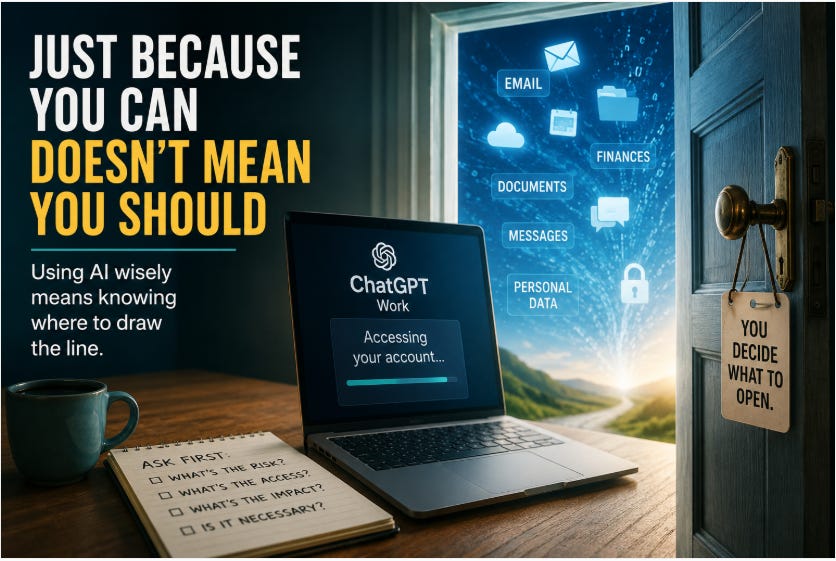
ChatGPT Work can now do more than research public websites or work with information you give it. It can access some websites that require you to log in and then continue working inside the account.
For example, you might tell ChatGPT to go to a website and complete a task. When the site requires a login, you take over and enter your password or two-factor authentication code. ChatGPT doesn’t need to know your password. Once you’re logged in, it can continue with the task.
That’s impressive.
It also raises an important question:
Just because AI can do something for us, does that mean we should let it?
The Password Isn’t Really the Point
At first, “I enter the password myself” sounds reassuring. And it is an important security protection.
But think about it another way.
Suppose I unlock my computer and hand it to someone. I haven’t told that person my password. But while the computer is unlocked, that person may be able to see and do quite a bit.
The same principle applies here.
The important question isn’t only, “Does AI know my password?”
It’s also, “What can AI access after I open the door?”
That could include account information, documents, messages, purchase history, addresses or other information stored behind the login.
OpenAI also says an authenticated website session may remain signed in for future tasks. That doesn’t automatically mean something bad will happen. It simply means we should understand what permission we are granting.
AI Is Moving From Answering to Acting
This is the bigger story.
We’ve become accustomed to asking AI questions:
Explain this.
Find this.
Compare these.
Summarize this document.
Now we’re entering the age of AI agents that can do things on our behalf.
That’s a significant change.
If ChatGPT gives me a bad answer about where to buy a frying pan, perhaps I’ve wasted a few minutes.
But what if an AI agent misunderstands instructions while operating inside an important account?
Computer-security experts have a useful term for thinking about this: blast radius.
It simply means: If something goes wrong, how much damage could it cause?
That’s the question I’d ask before allowing an AI agent into any account.
Not All Accounts Are Equal
I wouldn’t worry much about allowing AI to retrieve something from a low-risk subscription site.
But my primary email account? Financial accounts? Medical records? Tax information? Social Security or other government accounts?
That’s very different.
There’s another useful security principle called least privilege. It means giving a person or computer system only the access needed to accomplish a particular job—and no more.
We can apply that principle to AI.
Before giving an AI agent access to an account, ask:
What information is behind this login?
Can it send, change, purchase or delete anything?
Does the account contain information about other people?
Will the login remain active afterward?
Could I accomplish the same thing by downloading a document myself and giving AI only that document?
If something went wrong, what’s the worst realistic result?
That last question may be the most important.
Convenience Can Make Us Careless
For years, technology has trained us to click buttons without thinking very much:
Allow. Accept. Connect. Remember Me. Stay Signed In.
We usually just want to get past the screen and finish what we’re doing.
AI makes those permissions more important because increasingly we’re not merely giving technology permission to see information. We may be giving it permission to act for us.
That doesn’t make AI bad. It makes our judgment more important.
Personally, I’ll continue using ChatGPT for research, writing, explanations, analyzing documents and plenty of other things. If I need help understanding a financial statement, for example, I can download the statement myself and provide the document. AI can help me analyze it without needing access to the entire account.
That’s a tradeoff I’m perfectly happy to make.
New technology often gives us capabilities faster than we develop rules for using them wisely. AI is moving especially fast.
So perhaps we need to revive an old-fashioned bit of common sense:
Just because you can doesn’t mean you should.
The smartest way to use powerful technology isn’t necessarily to use every capability it offers.
Sometimes it’s knowing which doors you prefer to keep closed.
As always, do your own research and make up your own mind.
White paper on land and water rights: Property Rights and Freedom: A White Paper on America’s Disappearing Land (8/13/2025)
United we stand. Divided we fall. We must not let America fall.
VoteTexas.gov, https://www.votetexas.gov/get-involved/index.html
Disclaimer:
As always, do your own research and make up your own mind. This Substack is provided for informational and commentary purposes only. All claims or statements are based on publicly available sources and are presented as analysis and opinion, not legal conclusions.
No assertion is made of unlawful conduct by any individual, company, or government entity unless such claims are supported by formal public records or verified legal documents. The views expressed here reflect my personal perspective on property rights and land use issues.
While I strive for accuracy and transparency, readers are encouraged to verify all details using the official sources and references provided. Any references to third-party material are included solely for your consideration and do not necessarily reflect my views or imply endorsement.
If you share this content, please include this disclaimer to preserve context and clarity for all readers.
Until next time…
Please share your thoughts in the comments. Or email me, and let’s have a problem-solving conversation. I welcome ‘letters to the editor’ type emails and may publish yours. I hope we can create a caucus with positive, back-to-the-founders’-dream-for-America results. Have a topic you want to know more about?
Some housekeeping…
Going forward, you may need to check your spam folder. And please mark this address as ‘not spam.’ If the newsletter isn’t in your spam folder either, you should look in the Promotions tab.
You can always see everything on the website, RationalAmerican.org.
Thanks again for reading! I’m glad you’re here!
Came to the same decision on Work myself. I use ChatGPT for some research and for illustration. Thought I'd look at Work and decided I might as well let the AI take over the substack.