

Hi friends,
I’ve curated the below from several sources. This will give you an overview.
(January State of Play: Greenland)
When the idea of the United States taking a greater interest in Greenland first entered public discussion, many reacted with disbelief. To some, it sounded outdated — even absurd — as though modern nations no longer considered geography a serious factor in national security. Yet history suggests otherwise. Strategic geography has never stopped mattering; it simply faded from public conversation during decades of relative global stability.
That stability is no longer guaranteed.
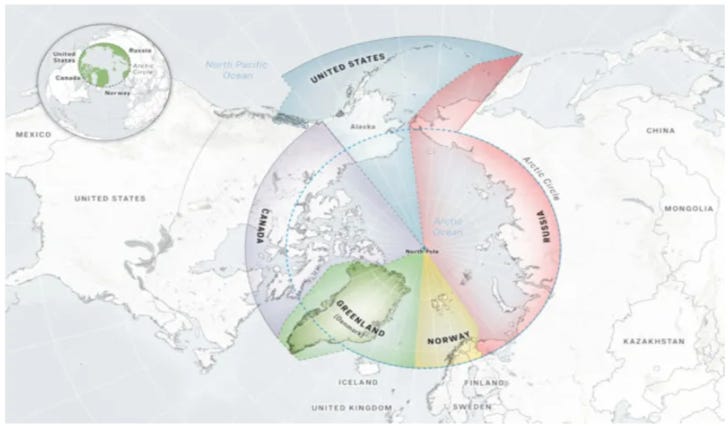
Greenland’s significance is not political or symbolic. It is geographic. Situated between North America and Europe, Greenland occupies one of the most strategically valuable positions in the Northern Hemisphere. As Arctic ice recedes and northern transit routes become more accessible, the region is emerging as a critical corridor for defense, surveillance, and global shipping.
The United States already maintains a permanent military presence there through Pituffik Space Base, which plays a key role in missile warning systems and space monitoring. From this location, early-warning capabilities extend across the Arctic — a region now seeing increased activity from both Russia and China.
Russia has invested heavily in Arctic militarization, expanding bases, modernizing ports, and operating the world’s largest fleet of icebreakers. China, though geographically distant, has declared itself a “near-Arctic state” and pursued economic and research initiatives throughout the region. These moves are not theoretical; they reflect long-term planning in anticipation of shifting trade routes and strategic advantage.
In this context, Greenland is not remote. It is central.
Some observers frame U.S. interest in Greenland as expansionist. In reality, it reflects a defensive posture — ensuring that a strategically vital region does not fall under the influence of adversarial powers. Throughout history, nations have taken responsibility for protecting critical locations not by “playing nice,” but by maintaining presence, deterrence, and readiness.
That principle has not changed.
This conversation also echoes an earlier chapter of American history. When the United States purchased Alaska in 1867, critics mocked the decision as “Seward’s Folly.” Few could envision its value at the time. Yet Alaska later proved indispensable during World War II, the Cold War, and beyond — economically, militarily, and strategically.
Greenland presents a similar moment of foresight.
Importantly, modern discussions surrounding Greenland are not about coercion or unilateral action. Any change in status would involve diplomacy, negotiation, and respect for the people of Greenland themselves. But acknowledging the region’s importance is not inappropriate — it is responsible.
Strategic awareness does not mean hostility. It means realism.
As the world enters a new era of competition — one shaped by geography, energy, minerals, technology, and defense — nations must plan for contingencies rather than assume permanence. Greenland illustrates this reality clearly: distance no longer insulates, and neglect no longer protects.
Understanding Greenland is not about predicting what will happen next.
It is about recognizing why serious nations prepare before circumstances force them to react.
In a changing world, foresight is not ambition.
It is prudence.
Sources:
U.S. Department of Defense – Arctic security and missile warning infrastructure
https://www.defense.gov/News/U.S. Space Force – Missile warning and space domain awareness
https://www.spaceforce.mil/The Epoch Times – Arctic geopolitics and Greenland coverage
https://www.theepochtimes.com/Council on Foreign Relations – Arctic strategy and emerging competition
https://www.cfr.org/RAND Corporation – Arctic security and great-power competition
https://www.rand.org/U.S. Department of State – Arctic policy and diplomacy
https://www.state.gov/
As always, do your own research and make up your own mind.
White paper on land and water rights: Property Rights and Freedom: A White Paper on America’s Disappearing Land
United we stand. Divided we fall. We must not let America fall.
VoteTexas.gov, https://www.votetexas.gov/get-involved/index.html
Disclaimer:
As always, do your own research and make up your own mind. This Substack is provided for informational and commentary purposes only. All claims or statements are based on publicly available sources and are presented as analysis and opinion, not legal conclusions.
No assertion is made of unlawful conduct by any individual, company, or government entity unless such claims are supported by formal public records or verified legal documents. The views expressed here reflect my personal perspective on property rights and land use issues.
While I strive for accuracy and transparency, readers are encouraged to verify all details using the official sources and references provided. Any references to third-party material are included solely for your consideration and do not necessarily reflect my views or imply endorsement.
If you share this content, please include this disclaimer to preserve context and clarity for all readers.
Until next time…
Please share your thoughts in the comments. Or email me, and let’s have a problem-solving conversation. I welcome ‘letters to the editor’ type emails and may publish yours. I hope we can create a caucus with positive, back-to-the-founders’-dream-for-America results. Have a topic you want to know more about?
Some housekeeping…
Going forward, you may need to check your spam folder. And please mark this address as ‘not spam.’ If the newsletter isn’t in your spam folder either, you should look in the Promotions tab.
You can always see everything on the website, RationalAmerican.org.
Thanks again for reading! I’m glad you’re here!