

Hi friends,
Below I’ve tried to capture the essence of Vivify Mariposa’s 7/8/2026 Substack.
I believe this perspective is really valuable. We know ‘news’ leaves a lot to be desired. Looking at the broader picture and putting some of the puzzle pieces together sure presents a different story.
Who Holds the Pen?
We usually read the news one story at a time: a tariff change, a new regulation, a tax bill, a court fight, a speech. But sometimes the more important question is whether those stories are part of a larger pattern. Who holds the pen? Who writes the rules, defines the words, controls the resources, sets the price, and makes the decisions?
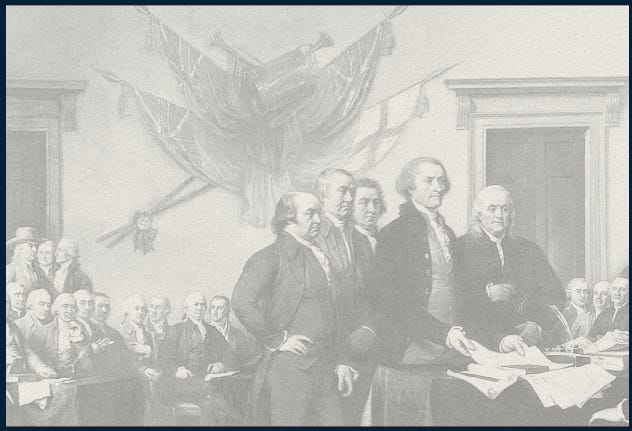
As America celebrates 250 years of independence, that seems like a particularly important question.
Food and Fertilizer
America grows enormous amounts of food, but farmers still depend on fertilizer and other inputs that can come through fragile foreign supply chains. A country is not fully food-secure if war, political conflict, or shipping disruptions can suddenly make it much harder or more expensive to grow crops. The issue is bigger than one tariff decision. It is about whether America controls enough of what it needs to feed itself.
Building Things Again (Permitting Rules)
Politicians have talked for years about bringing manufacturing back to America. But factories, mines, roads, power plants, and major infrastructure projects can spend years trapped in permits, studies, lawsuits, and regulatory delays. You do not have to ban industry if you make it almost impossible to build. So the real question is not whether leaders say they support American manufacturing, but whether Americans are actually allowed to build again.
Words Become Policy
The fights over words like “woman,” “sex,” and “gender” are not merely arguments over language. Once government changes the official meaning of a word, that definition affects schools, sports, prisons, military policy, civil-rights rules, grants, and statistics. Whoever controls the definition often shapes the policy before most people realize what happened. Words have power because government acts on the words it chooses to recognize.
Follow the Money
Tax debates can become so complicated that most people tune out. A simpler question is: Which direction is the money moving? Are workers, families, retirees, and small businesses keeping more of what they earn, or is more money flowing upward into government and large institutions? That does not answer every tax question, but it is a useful way to cut through the noise.
Who Gets to Tell America’s Story?
America’s 250th birthday is also a struggle over how we see ourselves. One vision emphasizes independence, the Constitution, sacrifice, achievement, freedom, and the duty to preserve what earlier generations built. Another focuses on division, failure, instability, and whether the country’s existing political and social order needs to be fundamentally changed. The argument is not just about history. It is about whether Americans still see their country as something worth preserving.
Control of Shipping Routes
Food, fuel, medicine, machinery, raw materials, and thousands of everyday products have to get from one place to another. If those routes are blocked, controlled, or made too expensive, the effects can quickly spread through the entire world’s economy. The real question is this: Who can keep goods moving, who can stop them, and who gets to set the terms?
Owners or Debtors?
Many young Americans begin adulthood with student loans, car payments, credit-card debt, and little or nothing they actually own. That creates a very different relationship with the economy than beginning with even a small share of productive assets. People who own part of the economy tend to think differently from people who only owe money into it. Broadening ownership may be one of the most important ideas hiding inside what otherwise looks like a small policy proposal. (To give children a financial start, Trump Accounts, the tax-advantaged children’s investment accounts created in last year’s tax law.)
The Pattern
Taken separately, these stories may seem unrelated: fertilizer, permits, definitions, taxes, history, shipping, investment accounts. Together, they raise a much bigger question about independence.
Can a country feed itself, build what it needs, define its own laws, preserve its own history, protect essential trade, and give ordinary citizens a real ownership stake in the future?
That doesn’t mean every policy is wise or every action will succeed. Political promises should always be measured against what is actually signed, funded, built, enforced, or changed.
But perhaps, as America marks 250 years, we should ask these questions more often:
Who holds the pen? Who controls the resource? Who defines the word? Who collects the money? And what actually changed?
Don’t just read the news—an endless stream of disconnected puzzle pieces, but view it as a record of whether the American people are becoming more independent or less.
As always, do your own research and make up your own mind.
White paper on land and water rights: Property Rights and Freedom: A White Paper on America’s Disappearing Land (8/13/2025)
United we stand. Divided we fall. We must not let America fall.
VoteTexas.gov, https://www.votetexas.gov/get-involved/index.html
Disclaimer:
As always, do your own research and make up your own mind. This Substack is provided for informational and commentary purposes only. All claims or statements are based on publicly available sources and are presented as analysis and opinion, not legal conclusions.
No assertion is made of unlawful conduct by any individual, company, or government entity unless such claims are supported by formal public records or verified legal documents. The views expressed here reflect my personal perspective on property rights and land use issues.
While I strive for accuracy and transparency, readers are encouraged to verify all details using the official sources and references provided. Any references to third-party material are included solely for your consideration and do not necessarily reflect my views or imply endorsement.
If you share this content, please include this disclaimer to preserve context and clarity for all readers.
Until next time…
Please share your thoughts in the comments. Or email me, and let’s have a problem-solving conversation. I welcome ‘letters to the editor’ type emails and may publish yours. I hope we can create a caucus with positive, back-to-the-founders’-dream-for-America results. Have a topic you want to know more about?
Some housekeeping…
Going forward, you may need to check your spam folder. And please mark this address as ‘not spam.’ If the newsletter isn’t in your spam folder either, you should look in the Promotions tab.
You can always see everything on the website, RationalAmerican.org.
Thanks again for reading! I’m glad you’re here!