

Hi friends,
Privacy and personal information remain in our minds and in the news. Cell phones are the biggest trackers.
What will the courts decide about the 4th Amendment? It’s another conundrum.
How to catch the bad guys while protecting the rights and privacy of the non-bad guys.
But, in the end, the only control we may be able to exercise over our phones is to leave them someplace we’re not.
This is one of the most important modern Fourth Amendment debates because it sits right at the intersection of:
privacy,
technology,
public safety,
government power,
and constitutional limits.
The legal and constitutional tension comes from a simple question:
Should the government be allowed to know where you were simply because you carried a phone?
And the answer becomes complicated because:
sometimes that information helps solve serious crimes,
and sometimes it can sweep up thousands of innocent people who were merely nearby.
What “Geofencing” Actually Means
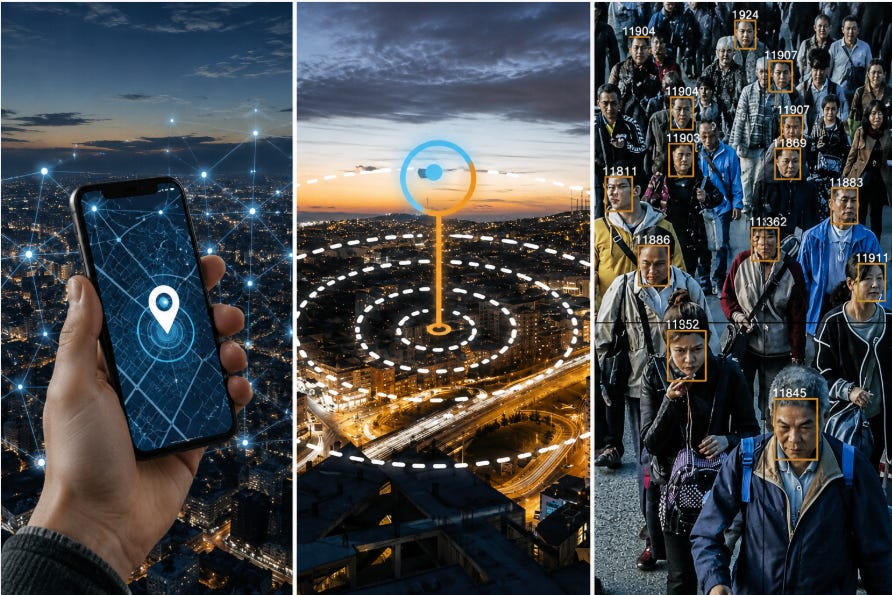
A geofence is a virtual boundary around a physical area.
Law enforcement can ask companies like Google for:
all devices detected within a geographic area,
during a certain time period.
Example:
“Give us all devices near this bank between 2:00–2:20 PM.”
That can produce:
suspects,
witnesses,
delivery drivers,
nearby residents,
random pedestrians,
journalists,
protesters,
tourists,
or innocent bystanders.
That is why geofence warrants are controversial.
Why This Raises Fourth Amendment Concerns
The Fourth Amendment protects against: “unreasonable searches and seizures.”
Traditionally, police needed:
probable cause,
tied to a specific person or place.
Geofence warrants reverse that logic.
Instead of: “We suspect John Doe.”
It becomes: “Give us everyone who was there, then we’ll figure out who interests us.”
That is where critics argue it starts resembling a:
“general warrant.”
General warrants were one of the abuses that helped trigger the American Revolution. British authorities used broad authority to search groups of people without individualized suspicion.
Many constitutional scholars see geofence warrants as potentially reviving that same concept digitally. And authority never seems to stay inside its boundaries.
The Key Supreme Court Foundation: Digital Privacy
Several Supreme Court cases have increasingly recognized that:
modern technology changes privacy expectations.
The biggest modern case is:
Carpenter v. United States
In Carpenter, the Supreme Court ruled that:
long-term cell phone location tracking generally requires a warrant.
Chief Justice John Roberts wrote that cell phones create: “an intimate window into a person’s life.”
The Court recognized that:
location data reveals:
political activity,
religion,
medical visits,
associations,
habits,
movements,
relationships.
That case did not directly decide geofence warrants, but it strongly influenced the debate.
The Core Constitutional Problem
The central legal issue is this:
Traditional Warrants
Traditional warrants are:
particularized,
narrow,
based on individualized suspicion.
Geofence Warrants
Geofence warrants are:
exploratory,
broad,
location-based first,
person-based second.
That creates tension with:
“particularity requirements” of the Fourth Amendment.
The Strongest Argument for Geofencing
Supporters argue:
1. Serious Crimes Need Modern Tools
Geofencing has reportedly helped solve:
murders,
kidnappings,
robberies,
arson,
serial crimes.
Example:
A phone present at:
a murder scene,
at exactly the right time,
then fleeing,
can become powerful evidence.
2. Society Already Shares Location Data Constantly
People voluntarily:
carry phones,
use GPS,
use apps,
share location data with tech companies.
Supporters argue: if private companies already possess the data, lawful warrants should access it.
3. Police Often Narrow Results in Stages
Law enforcement sometimes argues:
initial results are anonymized,
identities revealed later,
only after narrowing criteria.
Courts vary on whether that sufficiently protects privacy.
The Strongest Argument Against Geofencing
Critics argue:
1. Innocent People Become Investigative Targets
This is the biggest concern.
If:
5,000 people attended an event,
every one of them could enter a law enforcement database.
Even if they did nothing wrong.
That creates:
chilling effects,
fear of political participation,
fear of protest,
fear of attending religious services,
fear of association.
2. It Enables Mass Surveillance
The Founders never envisioned:
the government being able to retroactively reconstruct everyone’s movements.
Modern smartphones essentially create:
a passive tracking system.
Critics argue geofencing risks normalizing:
population-level surveillance.
3. Abuse Potential Is Enormous
This is where public trust becomes central.
People often evaluate geofencing differently depending on:
who is using it,
against whom,
and for what purpose.
That inconsistency is exactly why constitutional limits exist.
The Fourth Amendment is supposed to:
restrain government power regardless of politics.
A power acceptable today against:
“bad people” may later be used against:
political opponents,
activists,
religious groups,
journalists,
ordinary citizens.
Historically, many surveillance tools expanded beyond their original justification.
January 6 and the Constitutional Debate
Critics argue geofence-style techniques there became:
extremely broad,
politically charged,
and insufficiently individualized.
Supporters argue:
investigators were identifying people present during a federal crime.
The constitutional question is not necessarily:
“What was January 6?”
but rather:
“How broad can digital searches become before they violate constitutional protections?”
That distinction matters legally.
Election Monitoring and “True the Vote”
Consider election investigations.
Groups such as True the Vote have used commercially available location data to argue patterns of ballot trafficking.
Critics of those efforts argued:
location precision can be overstated,
datasets may not prove criminal conduct,
innocent movement patterns can look suspicious.
Supporters argued:
unusual repeated movements deserved investigation.
Again, same technology:
different political interpretation.
That is why constitutional analysis tries to focus on:
neutral standards,
not outcomes people happen to like.
Where Courts Seem To Be Heading
The trend appears mixed but increasingly cautious.
Several judges have already expressed concern that geofence warrants may be unconstitutional because they:
lack particularity,
resemble general searches,
sweep in innocent people.
Some courts have:
suppressed evidence,
or criticized broad geofence requests.
Others have allowed narrower versions.
From a purely constitutional logic standpoint, the most likely long-term outcome
Courts may eventually allow:
highly narrow,
tightly constrained,
serious-crime geofence warrants,
while rejecting:
broad dragnet searches.
Likely future standards may include:
smaller geographic areas,
shorter time windows,
stronger probable cause,
judicial oversight,
minimization rules,
deletion requirements,
limits on innocent-person retention.
The Broader Reality
The deeper issue is that technology evolved faster than constitutional doctrine. Your phone now reveals:
-where you sleep,
-shop,
-worship,
-protest,
-travel,
-meet,
-and socialize.
That creates power governments in prior centuries simply never possessed.
The constitutional system is still trying to adapt.
Can You Really Turn Off Location Tracking?
Partially.
But modern phones are difficult to make truly “dark.”
Even with:
GPS off,
apps disabled,
location permissions denied,
phones may still reveal data through:
cell tower connections,
Wi-Fi scanning,
Bluetooth,
carrier metadata,
app telemetry.
Are Faraday Bags Real?
Yes — if they are genuine and functioning properly.
These are often called:
Faraday bags,
signal-blocking bags,
RF shielding bags.
They attempt to block:
cellular,
GPS,
Wi-Fi,
Bluetooth,
signals.
When working correctly, they may prevent the phone from communicating externally.
But There Are Important Caveats
1. Many Cheap Bags Are Poor Quality
Some products sold online:
leak signals,
degrade over time,
fail at certain frequencies.
2. You Must Seal Them Properly
Even a small opening can defeat shielding.
3. The Phone May Reveal Location Again Once Removed
Once the phone reconnects:
carriers/apps may infer movement patterns.
4. Phones Themselves Still Store Data
Even disconnected phones may internally log:
movement,
Wi-Fi networks,
timestamps.
The Most Privacy-Protective Option
Strictly speaking, the most privacy-protective approach is:
powered-off device,
battery removed (if possible),
inside a tested Faraday container.
But modern sealed smartphones make true isolation harder than older phones.
Final Perspective
The real constitutional issue is less about:
“Is geofencing good or bad?”
and more:
“How much power should government have to reconstruct the movements of innocent citizens?”
That is why this debate is becoming so significant.
Technology has made:
mass location tracking possible,
while the Fourth Amendment was designed specifically to prevent:overly broad government searches.
Courts are now trying to determine where that constitutional line belongs in the smartphone era.
As always, do your own research and make up your own mind.
White paper on land and water rights: Property Rights and Freedom: A White Paper on America’s Disappearing Land
United we stand. Divided we fall. We must not let America fall.
VoteTexas.gov, https://www.votetexas.gov/get-involved/index.html
Disclaimer:
As always, do your own research and make up your own mind. This Substack is provided for informational and commentary purposes only. All claims or statements are based on publicly available sources and are presented as analysis and opinion, not legal conclusions.
No assertion is made of unlawful conduct by any individual, company, or government entity unless such claims are supported by formal public records or verified legal documents. The views expressed here reflect my personal perspective on property rights and land use issues.
While I strive for accuracy and transparency, readers are encouraged to verify all details using the official sources and references provided. Any references to third-party material are included solely for your consideration and do not necessarily reflect my views or imply endorsement.
If you share this content, please include this disclaimer to preserve context and clarity for all readers.
Until next time…
Please share your thoughts in the comments. Or email me, and let’s have a problem-solving conversation. I welcome ‘letters to the editor’ type emails and may publish yours. I hope we can create a caucus with positive, back-to-the-founders’-dream-for-America results. Have a topic you want to know more about?
Some housekeeping…
Going forward, you may need to check your spam folder. And please mark this address as ‘not spam.’ If the newsletter isn’t in your spam folder either, you should look in the Promotions tab.
You can always see everything on the website, RationalAmerican.org.
Thanks again for reading! I’m glad you’re here!