

Hi friends,
The U.S. economy is being hailed as the start of a new industrial revolution, fueled by AI, manufacturing, and investment. But behind the oh-so-positive platitudes, that growth is placing increasing pressure on land, water, energy, and communities across the nation. Here’s what you need to know.
Over the past few months, a clear narrative has taken hold. The U.S. economy is surging. Markets are hitting record highs. Investment is pouring in. And increasingly, analysts are using a phrase we haven’t heard in a long time: a new industrial revolution.
At first glance, it’s easy to see why. Major companies are committing hundreds of billions of dollars to artificial intelligence infrastructure. Manufacturing is showing signs of life again after years of decline. Policies aimed at reducing regulatory burdens and encouraging domestic investment are beginning to shape real-world decisions. By many traditional measures, the momentum is undeniable.
But if you’ve been following the headlines, you already know that big national narratives often leave something out.
And in this case, what’s missing is hard to ignore.
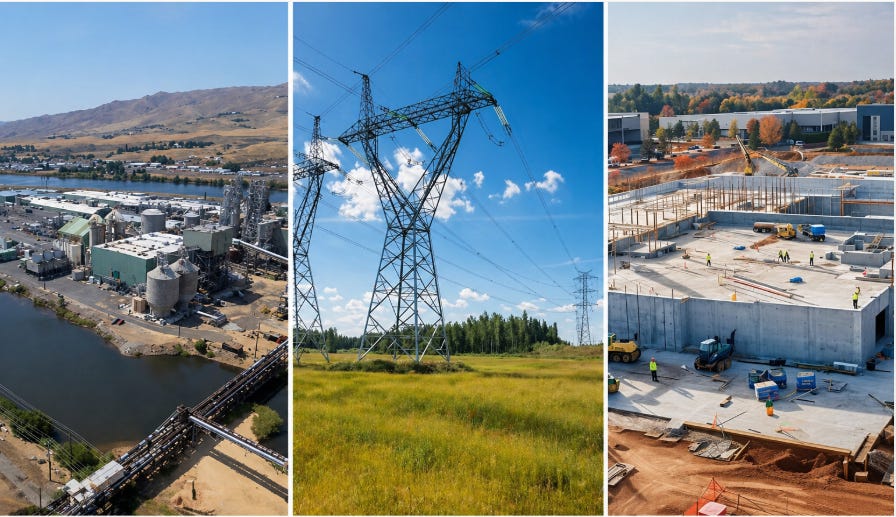
In just the past few weeks, the pace of development tied to this so-called industrial boom has become clearer—and faster. Projects aren’t just being discussed; they’re being proposed, planned, and, in some cases, pushed forward at a speed that’s catching local communities off guard. Data centers, energy infrastructure, and large-scale industrial sites are no longer abstract ideas. And a more recent concern, 765 kV transmission lines that travel halfway across the state by eminent domain. They are showing up in zoning meetings, permitting discussions, and local headlines.
And with them comes a reality that must be faced, and resolved, in the national conversation.
This kind of growth doesn’t happen in a vacuum. It requires enormous amounts of electricity. It depends on reliable access to also-enormous amounts of water. And it takes up land—often more than people expect. These aren’t minor inputs. They are foundational.
That’s where the conflict between landowners and residents and the big businesses and governmental entities stands out.
Across the country—and especially here in Texas—questions must be answered. Communities are asking where this water is coming from, how much will be needed, and who gets to decide. Landowners are taking a closer look at how infrastructure projects are sited and what that means for their property. Local officials are often NOT weighing economic opportunity against long-term resource strain.
These aren’t theoretical debates anymore. They’re happening in real time, and sometimes at warp speed.
Are we seeing this in the broader economic narrative, or does most coverage focus on growth, innovation, and investment. And those things matter.
But far less attention is given to how resources are allocated, how decisions are made at the local level, and what the long-term implications might be.
That gap matters a lot!
Because while economic growth may be measured state-wide or nationally, its impact is always felt locally. The decisions being made today about infrastructure, water use, and land development will shape communities for decades. Once these systems are in place, they are almost impossible to improve. And you can rest assured that some improvement WILL be needed.
None of this is to say that growth itself is a problem. Economic expansion, technological advancement, and investment can bring real benefits. But they also bring tradeoffs—and those tradeoffs deserve to be understood, not overlooked.
We are entering a moment where development is moving quickly, often faster than public awareness. Policies are being implemented ahead of broad community engagement. And long-term consequences—especially when it comes to land and water—are not always part of the initial conversation.
That’s why paying attention now matters.
There’s more to tell about this “industrial boom”, how it’s reshaping land use, where water demand fits into the equation, and why these decisions are unfolding the way they are.
Because if we’re going to talk about a new industrial revolution, we need to understand what it’s built on—and what it may cost.
Sources:
Houston Advanced Research Center (HARC) – Thirsty Data: Water Use and the Projected Data Center Boom in Texas (Jan 2026)
https://harcresearch.org/wp-content/uploads/2026/01/Thirsty-Data-Water-Use-and-The-Projected-Data-Center-Boom-in-Texas.pdf
EnergyCapitalHTX – HARC Data Center Water Supply Report Overview
https://energycapitalhtx.com/harc-data-center-water-supply-reportTexas Observer – AI Data Centers and Water Usage in Texas
https://www.texasobserver.org/texas-ai-data-centers-water-usage-regulation/
HARC Announcement / Summary Page – Thirsty Data: Hidden Water and Energy Costs
https://harcresearch.org/news/thirsty-data-the-hidden-water-and-energy-costs-of-texas-data-center-boom/
Save Texas Water (meeting presentation referencing report findings)
https://savetexaswater.org/meeting/doc/Minutes/doc/MCook---Thirsty-Data---1.27.2026.pdf
As always, do your own research and make up your own mind.
White paper on land and water rights: Property Rights and Freedom: A White Paper on America’s Disappearing Land
United we stand. Divided we fall. We must not let America fall.
VoteTexas.gov, https://www.votetexas.gov/get-involved/index.html
Disclaimer:
As always, do your own research and make up your own mind. This Substack is provided for informational and commentary purposes only. All claims or statements are based on publicly available sources and are presented as analysis and opinion, not legal conclusions.
No assertion is made of unlawful conduct by any individual, company, or government entity unless such claims are supported by formal public records or verified legal documents. The views expressed here reflect my personal perspective on property rights and land use issues.
While I strive for accuracy and transparency, readers are encouraged to verify all details using the official sources and references provided. Any references to third-party material are included solely for your consideration and do not necessarily reflect my views or imply endorsement.
If you share this content, please include this disclaimer to preserve context and clarity for all readers.
Until next time…
Please share your thoughts in the comments. Or email me, and let’s have a problem-solving conversation. I welcome ‘letters to the editor’ type emails and may publish yours. I hope we can create a caucus with positive, back-to-the-founders’-dream-for-America results. Have a topic you want to know more about?
Some housekeeping…
Going forward, you may need to check your spam folder. And please mark this address as ‘not spam.’ If the newsletter isn’t in your spam folder either, you should look in the Promotions tab.
You can always see everything on the website, RationalAmerican.org.
Thanks again for reading! I’m glad you’re here!
Kevin Warsh thinks he has a better way to prove it's real and when the senate votes his confirmation, we will know if he's right.
Warsh will need to rearchitect the Federal Reserve. Specifically, the measures, metrics and models the Fed has used for decades to measure and predict the state of our economy and the new Industrial boom phenomena.
He has stated that the first order of business will be to investigate alternative measures of inflation. Warsh believes that many economists have been correct in arguing that there are much better and more accurate measurements and metrics for understanding and predicting underlying inflationary pressures than the headline personal consumption expenditure price index or the core index. And they are certainly much better than the ad hoc indexes analysts like to cite to prove that inflation is really doing what their false narratives imply.
Warsh was critical of “Dubya’s” and Fed Chair Bernanke’s financial sleight-of-hand called quantitative easing (QE) back in 2008 and he also correctly argued that Fed Chair Jerome ((too late) Powell waited too long to pull back Biden's pandemic-era accommodative monetary policy.
Warsh has a record of changing his views on monetary policy when the facts change and NOT because of who is sitting in the Oval office. Let’s hope that’s the case moving forward.