

Hi friends,
Consider this.
Thesis:
America became weaker because manufacturing was outsourced, factories closed, supply chains moved overseas, and Wall Street prioritized finance over production.
Therefore:
The federal government should actively help rebuild American manufacturing capacity, especially in strategic industries.
And therefore:
Trump’s tariffs, energy policies, tax incentives, deregulation, defense spending, and industrial policies are all pieces of a coordinated effort to rebuild America’s productive economy.
America’s Course Correction
America did not arrive at this moment overnight.
For decades, leaders in both parties largely embraced the same economic model: globalization, free trade, outsourcing, financialization, and the belief that markets would naturally place production wherever it could be done most efficiently.
There were ‘benefits’. Consumers enjoyed lower prices. Companies increased profits. Global trade expanded. Technology advanced.
But there were costs as well. It seems we’ve learned the costs outweighed the benefits.
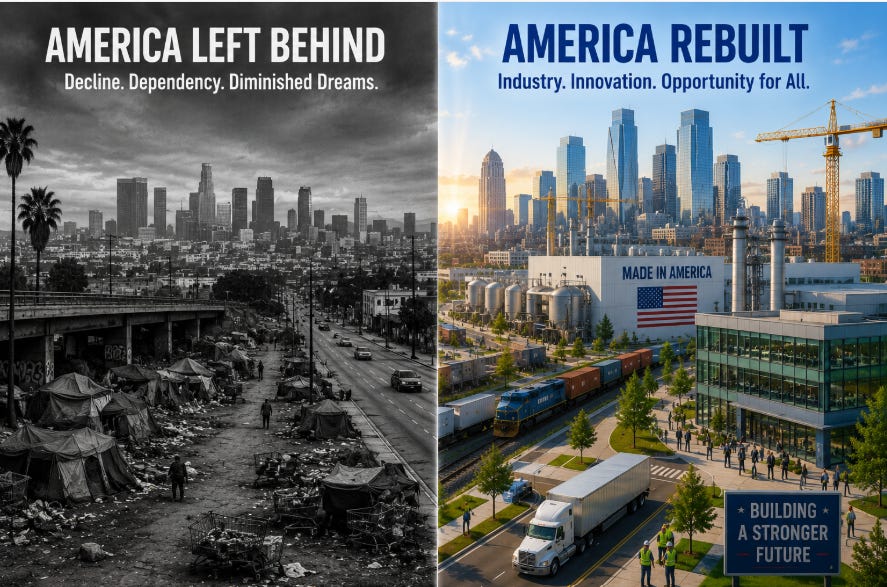
Factories closed. Manufacturing jobs disappeared. Supply chains stretched across oceans. Critical industries moved overseas. Many communities watched their economic foundations erode while Wall Street prospered.
Whether one calls it globalization, financialization, or simply the prevailing economic consensus, a growing number of Americans concluded that something was wrong.
Today, we are witnessing a deliberate shift in direction.
The Trump administration has made rebuilding America’s productive capacity a central goal. Through tariffs, deregulation, tax incentives, energy expansion, strategic investments, and defense procurement, the administration is attempting to encourage more production, manufacturing, and investment within the United States.
The objective is simple: make more things in America, build more things in America, and reduce dependence on foreign competitors for critical goods and materials.
Supporters argue that a nation cannot remain strong if it loses the ability to manufacture essential products, refine critical minerals, build ships, produce advanced technology, or maintain secure supply chains.
This effort extends beyond traditional manufacturing. It includes semiconductors, artificial intelligence infrastructure, energy production, shipbuilding, defense systems, and other industries viewed as vital to both economic prosperity and national security.
At the center of this approach is an old American idea: strong nations build things.
Factories are more than buildings. They create entire ecosystems of suppliers, engineers, skilled workers, transportation networks, research facilities, and supporting businesses. One successful manufacturing facility often generates opportunities far beyond its own walls.
This concept has deep roots in American history.
Alexander Hamilton argued that the young nation needed domestic manufacturing. Later generations built railroads, steel mills, power systems, shipyards, and industrial centers that helped transform the United States into the world’s leading economic power.
Advocates of today’s policies believe America must recover some of that productive strength after decades of offshoring and deindustrialization.
Of course, every course correction carries risks. Can government intervention can sometimes create waste, political favoritism, or investments that fail to deliver promised results? We know it can.
The challenge is balance.
America does not need government directing every aspect of the economy. But neither does it benefit from becoming dependent on foreign nations for critical industries and essential goods.
The goal is to rebuild what has been lost while preserving the innovation, entrepreneurship, and economic freedom that have long been America’s strengths.
Perfection is impossible. Every generation inherits challenges created by the decisions of previous generations. The question is not whether every policy is flawless. The question is whether the nation is moving toward greater strength, resilience, and opportunity.
Can America once again become a nation that not only consumes and finances, but also designs, manufactures, builds, and produces?
There is growing recognition across the political spectrum that a strong America requires more than financial markets and consumer spending. It requires the capacity to create the products, technologies, infrastructure, and industries on which both prosperity and national security depend.
Is this course correction a good thing? Well, in my opinion, America certainly could not have survived on the previous course.
Sources:
https://brianlantz.substack.com/p/the-factory-is-the-product
https://www.brookings.edu/articles/alexander-hamiltons-manufacturing-message/
As always, do your own research and make up your own mind.
White paper on land and water rights: Property Rights and Freedom: A White Paper on America’s Disappearing Land (8/13/2025)
United we stand. Divided we fall. We must not let America fall.
VoteTexas.gov, https://www.votetexas.gov/get-involved/index.html
Disclaimer:
As always, do your own research and make up your own mind. This Substack is provided for informational and commentary purposes only. All claims or statements are based on publicly available sources and are presented as analysis and opinion, not legal conclusions.
No assertion is made of unlawful conduct by any individual, company, or government entity unless such claims are supported by formal public records or verified legal documents. The views expressed here reflect my personal perspective on property rights and land use issues.
While I strive for accuracy and transparency, readers are encouraged to verify all details using the official sources and references provided. Any references to third-party material are included solely for your consideration and do not necessarily reflect my views or imply endorsement.
If you share this content, please include this disclaimer to preserve context and clarity for all readers.
Until next time…
Please share your thoughts in the comments. Or email me, and let’s have a problem-solving conversation. I welcome ‘letters to the editor’ type emails and may publish yours. I hope we can create a caucus with positive, back-to-the-founders’-dream-for-America results. Have a topic you want to know more about?
Some housekeeping…
Going forward, you may need to check your spam folder. And please mark this address as ‘not spam.’ If the newsletter isn’t in your spam folder either, you should look in the Promotions tab.
You can always see everything on the website, RationalAmerican.org.
Thanks again for reading! I’m glad you’re here!