

Hi friends,
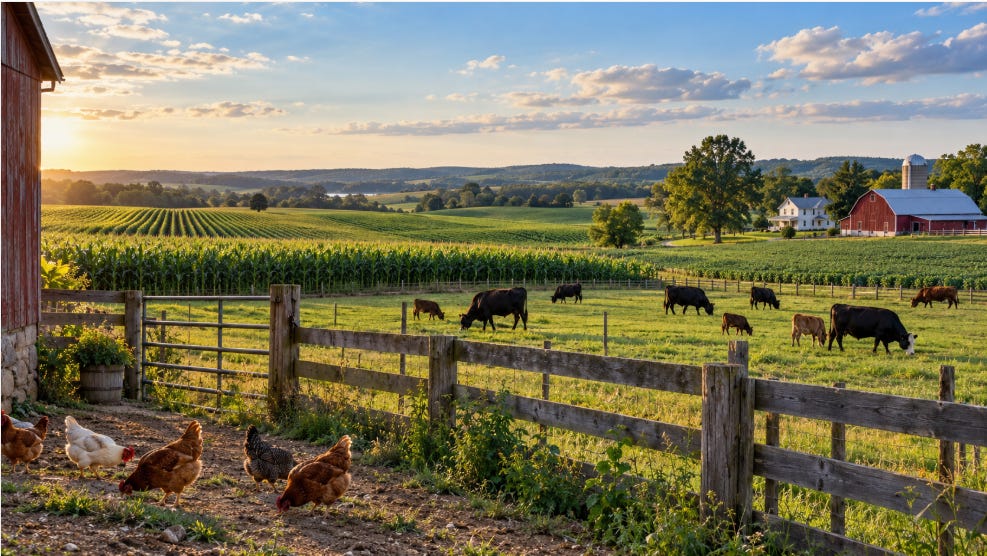
America needs artificial intelligence. It also needs the farms and ranches that feed our people. When data centers replace productive agricultural land, the country is making a decision about its future food-producing capacity—not simply finding room for a needed business.
Food security depends partly on having dependable land available to grow crops and feed livestock. Losing that land weakens this foundation, even if higher yields elsewhere can offset some lost production. The concern is long-term capacity and resilience.
Data centers are entering a landscape already reshaped by housing, roads, industry and energy development. USDA found that about 70 percent of large-scale solar projects and more than 90 percent of wind turbines installed in rural areas during 2012–2020 were on agricultural land.
Those uses affect farmland differently. Crops and grazing commonly continue around wind turbines. Some solar projects allow grazing or crop production, while others displace it. Buildings, paved areas and access roads remove their footprints from agricultural production. We should count the land actually displaced.
Large data-center campuses add another demand for substantial, connected tracts. In Red Oak, Texas, for example, roughly 800 acres received zoning approval for a data-center development on land with documented agricultural classifications and crop-cover evidence. That shows why agricultural use belongs near the beginning of the decision though it doesn’t mean 800 acres have already been converted.
The consequences extend beyond the acreage under buildings. Dividing farms can interrupt access, separate fields from water and leave smaller pieces harder to operate or undesirable. As working farmland disappears, the surrounding network of suppliers, equipment services and agricultural businesses are adversely affected. A remaining field needs a functioning farm economy around it.
Productive soil also deserves more respect than the label “vacant land” suggests. Grading, removing topsoil and paving can make a return to agriculture difficult and expensive. A promise to restore land may not be viable when the time comes.
The first safeguard is better siting. Compare existing industrial sites and other suitable locations before converting productive farms. Identify prime soils, irrigation investments and working ranch acreage. Consider layouts that preserve connected agricultural areas and farm access. Include land needed for supporting power infrastructure in the assessment. Data centers require a lot of supporting infrastructure as well as setbacks for noise and light.
Owners’ choices matter. Protecting farmland should respect private property rights and favor workable, voluntary approaches. But public incentives and planning decisions must recognize agricultural capacity as an asset, rather than valuing land only by what the next development might pay.
Americans must track the cumulative conversion of farm and ranch land across projects and regions. Otherwise, decisions made one parcel at a time can add up to disaster.
We can pursue leadership in AI while insisting that farmland receive serious consideration before conversion.
Our ability to produce food is part of national strength. It deserves the same forward-looking attention we give the technologies we hope will shape our future.
Sources:
USDA—Agricultural land near solar and wind projects:
https://www.ers.usda.gov/amber-waves/2024/september/agricultural-land-near-solar-and-wind-projects-usually-remained-in-agriculture-after-developmentDepartment of Energy—Combining solar with farming and grazing:
https://www.energy.gov/cmei/systems/agrivoltaics-solar-and-agriculture-co-locationUSDA NRCS—Farmland protection and conversion:
https://www.nrcs.usda.gov/conservation-basics/land/cropland/farmland-protection-policy-actAmerican Planning Association—Farmland protection and fragmentation:
https://www.planning.org/knowledgebase/farmlandprotection/USDA NRCS—Example of preserving connected, productive farmland:
https://www.nrcs.usda.gov/state-offices/montana/news/kamps-seed-farm-conserved-494-acres-of-primeRed Oak—Official zoning ordinance for the approximately 800-acre development:
https://ecode360.com/RE6455/laws/LF2738431.pdf
As always, do your own research and make up your own mind.
White paper on land and water rights: Property Rights and Freedom: A White Paper on America’s Disappearing Land (8/13/2025)
United we stand. Divided we fall. We must not let America fall.
VoteTexas.gov, https://www.votetexas.gov/get-involved/index.html
Disclaimer:
As always, do your own research and make up your own mind. This Substack is provided for informational and commentary purposes only. All claims or statements are based on publicly available sources and are presented as analysis and opinion, not legal conclusions.
No assertion is made of unlawful conduct by any individual, company, or government entity unless such claims are supported by formal public records or verified legal documents. The views expressed here reflect my personal perspective on property rights and land use issues.
While I strive for accuracy and transparency, readers are encouraged to verify all details using the official sources and references provided. Any references to third-party material are included solely for your consideration and do not necessarily reflect my views or imply endorsement.
If you share this content, please include this disclaimer to preserve context and clarity for all readers.
Until next time…
Please share your thoughts in the comments. Or email me, and let’s have a problem-solving conversation. I welcome ‘letters to the editor’ type emails and may publish yours. I hope we can create a caucus with positive, back-to-the-founders’-dream-for-America results. Have a topic you want to know more about?
Some housekeeping…
Going forward, you may need to check your spam folder. And please mark this address as ‘not spam.’ If the newsletter isn’t in your spam folder either, you should look in the Promotions tab.
You can always see everything on the website, RationalAmerican.org.
Thanks again for reading! I’m glad you’re here!