

Hi friends,
Data centers are a big controversy these days. For good reasons. Three of the top reasons are water use, energy use, rural land ‘taking’.
Another reason for many people is the surveillance usage, risk to privacy, digital control. (You know if it can be abused, it will be.)
When Americans Say “Not Here,” Maybe We Should Ask Why
A new Gallup poll found that seven in ten Americans oppose building artificial intelligence data centers in their local area. That is not a small hesitation. That is a national warning light.
Gallup reported that 71% of Americans oppose constructing AI data centers in their local area, including 48% who strongly oppose it. Barely a quarter favor the idea, and only 7% strongly favor it. The poll was conducted March 2–18, 2026, and Gallup noted that opposition crosses political and demographic lines.
That’s huge.
Because this debate is too often framed as if communities are either “pro-technology” or “anti-progress.” But that is not what I hear when people raise concerns about data centers. Most people are not against technology. They are against being bypassed.
They are against massive industrial projects arriving before the public has clear answers.
They are against being told everything is fine when the reality is that water, electricity, land, roads, emergency services, and utility bills may be affected for decades.
They are against decisions being made first, explained later, and regretted indefinitely.
This Is Not Just About AI
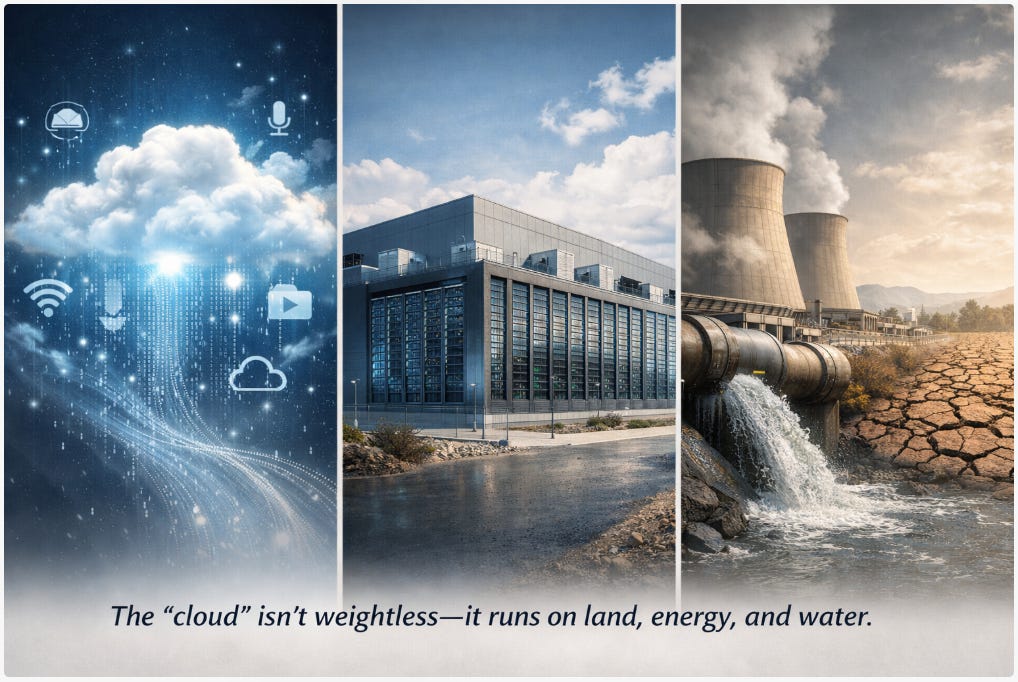
Artificial intelligence may be the shiny object in the room, but data centers are not imaginary. They are physical, industrial-scale facilities. They require land. They require electricity. Many require significant water for cooling, directly or indirectly. They may require new transmission lines, substations, backup power systems, roads, emergency planning, and utility infrastructure.
In other words, they do not simply “live in the cloud.”
They live somewhere.
And the people who live near that “somewhere” deserve to know what is coming.
That is why the Gallup poll is important. It gives national confirmation to what local communities are already sensing. People are not just reacting emotionally. They are asking practical questions.
What will this do to our water supply? What will this do to our electric grid? What will this do to our rates? What happens during drought? Who pays for infrastructure upgrades? What happens if promises about jobs, water use, or tax benefits do not materialize?
Those are not anti-technology questions.
Those are citizen questions.
Texas Is Already on the Front Line
Texas is becoming one of the major battlegrounds in this discussion because Texas has land, energy infrastructure, business incentives, and a political environment that often welcomes large-scale development. That can bring benefits. But it can also create enormous pressure on communities that may not have the authority, information, or time to fully evaluate what is being proposed.
A 2026 HARC report, Thirsty Data and the Lone Star State, estimated that existing Texas data centers consume about 25 billion gallons of water, including both direct and indirect water use. HARC estimated that if growth projections hold, Texas data center water demand could rise to 29–161 billion gallons by 2030.
Those numbers should get our attention.
At the statewide level, data center water use may still look like a relatively small percentage. But that is not how water stress is experienced on the ground. Water problems are often local and regional. A project that looks manageable in a statewide spreadsheet may be very significant in a specific watershed, aquifer, city, or rural county.
And water is not the only concern.
The Texas Tribune reported in 2025 that data centers use water both directly, for cooling, and indirectly, through the electricity they consume. The same report noted that Texas data centers already required a very large amount of electricity and that data centers were expected to help drive Texas power demand sharply higher by 2030.
That means the issue is not only whether a data center has a water-efficient cooling system. It is also whether the broader electric demand creates more pressure on the grid, more generation needs, more transmission buildout, and potentially higher costs for ordinary Texans.
That is where the “people first” question becomes unavoidable.
Are communities being asked to accommodate enormous infrastructure demands before they have even been told the full picture?
Hill County Hit the Pause Button
This is why Hill County’s recent action is so important.
In May 2026, Hill County approved a one-year pause on new data center construction in unincorporated areas, citing public health and public safety concerns. The Texas Tribune described it as a rural Texas county pausing new data center construction while the county studies the impacts.
That pause should not be viewed as hostility toward innovation. It should be viewed as basic prudence.
When a county says, “Wait — we need answers first,” that is not obstruction. That is governance.
KWTX reported that the moratorium does not permanently shut the door on data centers but creates a pause so the county can research impacts on public safety and infrastructure.
That distinction matters. A pause is not a ban. A pause is a request for time, facts, and accountability.
And frankly, if a project is good for a community, it should be able to survive public scrutiny.
The Real Question: Who Benefits, Who Pays, and Who Decides?
Every major infrastructure debate eventually comes down to a few basic questions.
Who benefits?
Who pays?
Who decides?
Who carries the risk if the projections are wrong?
With data centers, the benefits are often described in broad, exciting language: innovation, economic development, tax base growth, modernization, artificial intelligence, competitiveness, and jobs.
Some of those benefits may be real.
But the costs are often local, physical, and long-term.
A rural community may face new demands on roads, substations, water supplies, fire response, emergency planning, and land use. Residents may worry about noise, lighting, traffic, aquifer depletion, utility rates, and whether public resources are being redirected to serve private industrial users.
If a company receives tax incentives, who makes up the difference?
If new power infrastructure is needed, who pays?
If water projections prove too optimistic, who suffers?
If emergency services need specialized equipment or training, who funds it?
If the project changes the character of a rural area, who gets a vote?
These are not small questions, and they should not be brushed aside with slogans about progress.
People Are Not the Obstacle
One of the most troubling trends in modern development debates is the tendency to treat local residents as obstacles.
If citizens ask questions, they are called uninformed.
If they raise concerns, they are called anti-growth.
If they organize, they are accused of standing in the way of the future.
But in a constitutional republic, citizens are not obstacles to the process.
Citizens are the process.
Local people have every right to ask what will happen to their water, their land, their power bills, their roads, their emergency services, and their quality of life. They have every right to ask whether promises are enforceable. They have every right to demand transparency before approval.
And they have every right to say that technology should serve people, not the other way around.
The Gallup poll should be a wake-up call because it shows that this concern is not isolated. It is not just one county, one town, or one group of activists. It is widespread.
Americans may use AI. They may appreciate technology. They may understand that data centers are part of the modern economy.
But many do not want large-scale AI infrastructure built near them without serious protections in place.
That is not irrational.
That is human.
Transparency Before Trust
If companies and government officials want the public to trust this buildout, they need to stop expecting blind acceptance.
Communities need clear answers before approval, not after.
They need water-use estimates that distinguish between direct and indirect water demand.
They need electric-load projections and an explanation of how those loads affect the grid.
They need ratepayer impact studies.
They need disclosure of tax abatements, subsidies, or public incentives.
They need emergency-response plans.
They need noise, traffic, and land-use studies.
They need drought-contingency planning.
They need enforceable promises, not glossy presentations.
And they need local officials willing to represent residents first, not simply repeat the talking points of developers, lobbyists, or state-level growth agendas.
Because once land is converted, infrastructure is built, and contracts are signed, it becomes much harder for local residents to unwind a bad deal.
That is why planning matters.
That is why transparency matters.
That is why the public deserves more than reassurances.
A Better Path Forward
The point is not that every data center is bad.
The point is that every data center should be evaluated honestly.
Some may be appropriate in certain locations. Some may use better cooling systems. Some may bring legitimate economic benefits. Some may be designed in ways that reduce water stress, protect residents, and pay their own way.
But “some may be beneficial” is not the same as “approve them all.”
A responsible approach would put people ahead of technology.
That means no automatic approvals.
No hidden incentives.
No vague water promises.
No shifting infrastructure costs onto ordinary ratepayers.
No dismissing local residents as anti-progress.
No pretending that “the cloud” has no footprint.
The better path is simple: slow down, disclose the facts, study the impacts, protect local resources, and let communities have a meaningful voice.
That is not anti-AI.
That is pro-accountability.
Important!
The Gallup poll tells us something important. Americans are not merely nervous about artificial intelligence. They are concerned about what the AI buildout may require from their communities.
They are asking whether the benefits will be shared while the costs are localized.
They are asking whether water, power, land, and public infrastructure are being committed before citizens have a chance to understand the tradeoffs.
And they are asking whether technology is being placed ahead of people.
Those questions deserve answers.
Before we build the future, we should be honest about who is being asked to pay for it.
Sources:
Gallup — “Americans Oppose AI Data Centers in Their Area”
https://news.gallup.com/poll/709772/americans-oppose-data-centers-area.aspx
HARC — “Thirsty Data and the Lone Star State: The Impact of Data Center Growth on Texas’ Water Supply”
https://harcresearch.org/wp-content/uploads/2026/01/Thirsty-Data-Water-Use-and-The-Projected-Data-Center-Boom-in-Texas.pdf
Texas Tribune — “Data centers are thirsty for Texas’ water, but state planners have limited information”
https://www.texastribune.org/2025/09/25/texas-data-center-water-use/
Texas Tribune — “Texas county pauses data center construction in rural areas”
https://www.texastribune.org/2026/05/12/texas-hill-county-approves-data-center-construction-pause-ai/
KWTX — “Hill County commissioners approve 1-year moratorium on data center construction”
https://www.kwtx.com/2026/05/12/hill-county-commissioners-approve-1-year-moratorium-data-center-construction/
As always, do your own research and make up your own mind.
White paper on land and water rights: Property Rights and Freedom: A White Paper on America’s Disappearing Land
United we stand. Divided we fall. We must not let America fall.
VoteTexas.gov, https://www.votetexas.gov/get-involved/index.html
Disclaimer:
As always, do your own research and make up your own mind. This Substack is provided for informational and commentary purposes only. All claims or statements are based on publicly available sources and are presented as analysis and opinion, not legal conclusions.
No assertion is made of unlawful conduct by any individual, company, or government entity unless such claims are supported by formal public records or verified legal documents. The views expressed here reflect my personal perspective on property rights and land use issues.
While I strive for accuracy and transparency, readers are encouraged to verify all details using the official sources and references provided. Any references to third-party material are included solely for your consideration and do not necessarily reflect my views or imply endorsement.
If you share this content, please include this disclaimer to preserve context and clarity for all readers.
Until next time…
Please share your thoughts in the comments. Or email me, and let’s have a problem-solving conversation. I welcome ‘letters to the editor’ type emails and may publish yours. I hope we can create a caucus with positive, back-to-the-founders’-dream-for-America results. Have a topic you want to know more about?
Some housekeeping…
Going forward, you may need to check your spam folder. And please mark this address as ‘not spam.’ If the newsletter isn’t in your spam folder either, you should look in the Promotions tab.
You can always see everything on the website, RationalAmerican.org.
Thanks again for reading! I’m glad you’re here!